
What Are Connectors: Key Takeaways
- Connectors are critical to system reliability, helping ensure stable signal transmission, consistent power delivery, and long-term performance across electronic systems
- Choosing the right connector type early on can simplify design decisions and prevent performance or integration issues later
- Material and design choices like plating, contact quality, and structure have a direct impact on durability and real-world reliability
- Working with the right sourcing partner helps reduce risk, avoid delays, and ensure you’re building with components you can trust
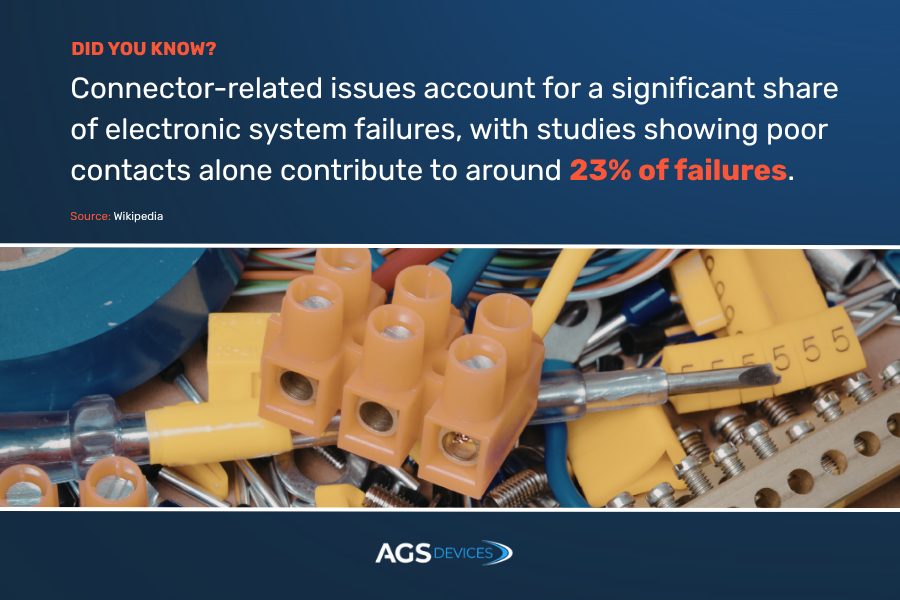
Connectors are responsible for a significant share of failures in electronic systems, with industry reliability studies (including NASA and military handbooks) consistently identifying interconnects and connectors as leading causes of faults in harsh environments.
So, what are connectors? They are the interface layer of electronics, enabling components and systems to communicate, transfer power, and function as a unified whole. Without connectors, there is no modularity, no serviceability, and no scalable system design.
For engineers, connectors directly impact signal integrity, performance, and durability. For procurement teams, they influence reliability, availability, and long-term supply continuity. In both cases, the right connector choice can prevent failures, reduce downtime, and improve overall system efficiency.
In this guide, we’ll cover:
- Connector definition and function
- How connectors work
- Types and classifications
- Materials and design factors
- Applications across industries
- How to select the right connector
Connectors in Electronics: Definition, Functions, and Key Facts
At a basic level, connectors are what allow separate parts of a system to actually work together.
They create a reliable path for power and data to move between components, without making those connections permanent.
That flexibility is what makes modern electronics possible. It’s how systems stay serviceable, scalable, and easier to manage over time.
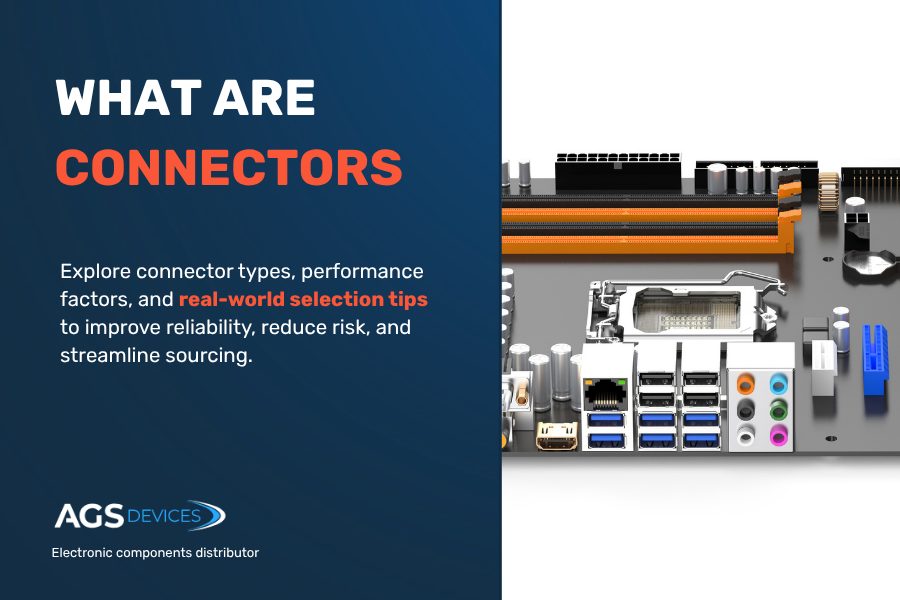
Common examples include USB, HDMI, and PCIe connectors, which allow internal components and external devices to communicate efficiently.
You’ll find connectors across every level of electronic design. They are used in:
- PCB connections: Linking components within a circuit board
- Cable assemblies: Connecting subsystems over distance
- External interfaces: Ports and sockets for user interaction
- At their core, connectors perform several essential functions:
- Signal transmission: Enabling data and communication flow
- Power delivery: Distributing electrical current across systems
- Mechanical connection: Supporting modular design and maintenance
- Grounding and shielding: Reducing noise and improving safety
The key insight is this: connectors are not passive components. Their design and quality directly impact signal integrity, system reliability, and overall lifespan.
Common Types of Connectors
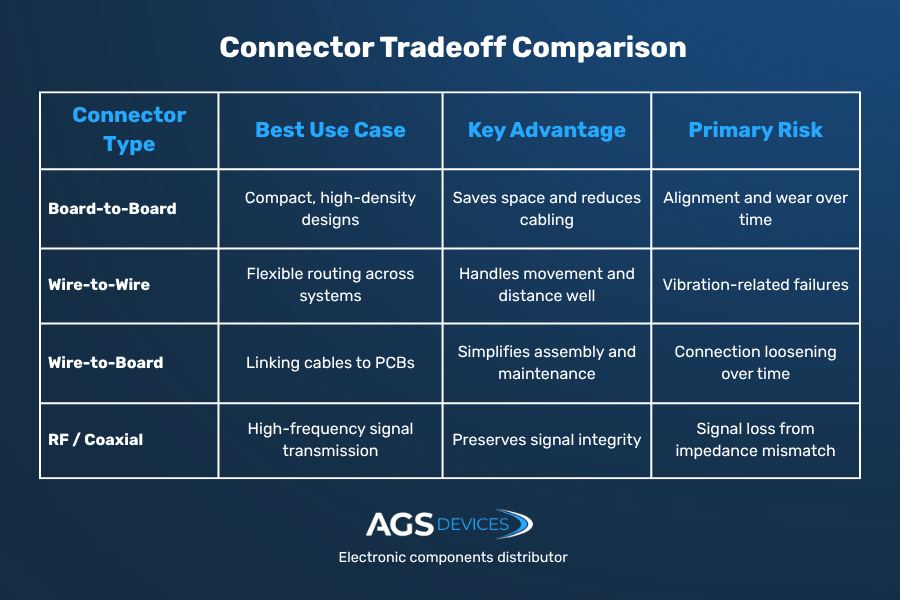
Connectors are designed for specific electrical and mechanical roles. The type you choose directly affects signal integrity, durability, and system scalability. Here’s how the most common connector types function in real-world systems.
Board-to-Board Connectors
Board-to-board connectors are all about saving space. Instead of using cables, they allow PCBs to connect directly, something you’ll see in compact devices like smartphones and embedded systems.
In fact, a single smartphone can rely on dozens of these connections to keep components tightly integrated without increasing size.
Wire-to-Wire Connectors
When systems need flexibility, especially across larger distances wire-to-wire connectors come into play.
You’ll find them everywhere in automotive and industrial environments, where connections need to handle movement, vibration, and long-term wear.
Example: A modern vehicle can contain over 1,500 wire-to-wire connections, supporting everything from engine control units to infotainment systems. These connectors must withstand vibration, temperature changes, and long-term wear.
Wire-to-Board Connectors
Wire-to-board connectors bridge cables to PCBs, enabling power and signal transfer between external wiring and internal circuits. They are common in consumer electronics and power supply units.
Use case: In devices like laptops and home appliances, wire-to-board connectors simplify assembly and allow faster maintenance or replacement without reworking the PCB.
RF & Coaxial Connectors
RF (radio frequency) and coaxial connectors are designed for high-frequency signal transmission, where signal loss and interference must be tightly controlled.
- SMA connectors: Used in RF modules, antennas, and test equipment
- BNC connectors: Common in video systems and lab instrumentation
Did you know? Even a small impedance mismatch in RF connectors can cause signal reflections and measurable data loss, which is critical in applications like 5G, radar, and aerospace communication systems.
Data Connectors (Computer Connectors)
Data connectors enable communication between devices and systems. Common examples include USB, HDMI, and Ethernet connectors.
Real-world impact:
- USB-C can deliver up to 240W of power and high-speed data, replacing multiple legacy connectors
- Ethernet connectors support data rates from 1 Gbps to 400 Gbps in modern data centers
- These connectors are essential for both consumer devices and enterprise infrastructure.
Power Connectors
Power connectors are built to handle higher currents and ensure stable electrical delivery. They are used in power supplies, industrial equipment, and energy systems.
Example: In electric vehicles (EVs), power connectors must safely handle hundreds of amps, supporting battery systems and fast-charging infrastructure without overheating or failure.
Connector Materials and Design Considerations
Connector performance depends heavily on both material selection and physical design. The right combination ensures low resistance, long lifespan, and stable operation under real-world conditions.
Conductive Materials
At the core of every connector is its conductive base, typically made from copper alloys. These materials offer a balance of high electrical conductivity and mechanical strength, allowing connectors to carry current efficiently while maintaining structural integrity over repeated use.
Plating Materials
Plating improves surface performance, especially at contact points where reliability is critical:
- Gold: Provides excellent corrosion resistance and stable conductivity over time
- Tin: A more cost-effective option, commonly used in less demanding environments
Gold plating is often preferred in high-reliability systems where even minor signal degradation is unacceptable.
Housing Materials
The connector housing protects internal contacts and ensures electrical insulation:
- Thermoplastics: Widely used for durability and cost efficiency
- High-temperature polymers: Designed for harsh environments with elevated heat or chemical exposure
Material choice here affects not just protection, but also thermal stability and safety.
Design Factors That Impact Performance
Beyond materials, connector design plays a major role in reliability:
- Contact spacing and density: Determines how compact and high-speed the connector can be
- Locking mechanisms: Prevent accidental disconnection in high-vibration environments
- EMI shielding: Reduces interference and preserves signal integrity
How to Choose the Right Connector
Choosing a connector isn’t just about matching a datasheet, it’s about understanding how that part will behave in the real world.
Here’s what to look at first.
Start With Electrical Requirements
Every connector must align with the electrical demands of the application. Voltage and current ratings define how much load it can safely carry, while the signal type determines how sensitive the connection is to noise or loss.
For example, high-speed data systems require tight impedance control, while power applications prioritize low resistance and thermal stability.
Ensure Proper Mechanical Fit
The connector also needs to physically integrate into the design without introducing weak points. Compact devices often require high-density connectors, while larger systems may prioritize durability and ease of handling.
Key considerations include:
- Size constraints within the enclosure
- Locking mechanisms for secure connections
- Durability across repeated mating cycles
Mechanical failure is one of the most common real-world issues, especially in systems exposed to movement or frequent use.
Design for the Operating Environment
Environmental conditions play a major role in connector lifespan. A connector that performs well in controlled settings may fail quickly in the field if exposed to stress factors like heat, moisture, or vibration.
In demanding applications, connectors must withstand:
- Temperature extremes that affect material stability
- Vibration that can loosen or fatigue contacts
- Exposure to dust, moisture, or chemicals that accelerate corrosion
This is particularly important in automotive, aerospace, and industrial systems.
Addressing a Common Concern: Open Market Risk
If you’re sourcing connectors outside of manufacturer-direct channels, risk is usually the first concern and understandably so.
Not all independent suppliers operate the same way.
At AGS Devices, every component goes through strict quality checks, traceability validation, and supplier vetting. That means you’re not just sourcing parts, you’re reducing uncertainty in your supply chain.
For procurement teams, that distinction matters.
Reliable Connector Sourcing Starts with AGS Devices
Connectors are fundamental to every electronic system. They determine how reliably signals are transmitted, how efficiently power is delivered, and how easily systems can be assembled, maintained, and scaled.
Choosing the right connector isn’t just a design decision. It’s a long-term reliability and supply chain decision.
At AGS Devices, we work with teams who can’t afford uncertainty in their supply chain.
Whether you’re dealing with hard-to-find parts or trying to avoid delays, our role is simple: help you source the right components with confidence.
That includes:
- Global sourcing network: Access to trusted, vetted suppliers worldwide
- Hard-to-find components: Including specialized and obsolete connectors
- BOM optimization: Reduce cost, complexity, and sourcing risk
- Quality assurance: Fully traceable, tested components
- Obsolescence management: Prevent redesigns and production delays
In addition to connectors, we also source electronic components such as:
Whether you’re building consumer electronics, automotive systems, industrial automation, or aerospace applications, AGS Devices helps you secure connectors that meet both performance and supply chain demands.
What Are Connectors: FAQs
If you’re still asking yourself, “what are connectors?” and you need additional answers, you might find them here.
What are connectors in electronics?
Connectors are components used to join electrical circuits, enabling the transfer of signals or power between devices. They allow systems to be easily assembled, disconnected, and maintained without permanent connections.
What is a connector in a computer?
A connector in a computer is an interface that allows hardware components to communicate. Examples include USB, HDMI, and PCIe connectors, which link internal parts or external devices for data and power transfer.
What are connectors used for?
Connectors are used to ensure reliable electrical connections across systems. They support communication between components, distribute power, and enable modular system design in applications ranging from consumer electronics to industrial equipment.
What are the types of connectors in computer networks?
Common types of connectors in computer networks include Ethernet (RJ45), fiber optic connectors (such as LC and SC), and coaxial connectors. These are designed to support high-speed data transmission with minimal signal loss.
Why is connector quality important in electronics?
Connector quality directly affects signal integrity, power efficiency, and system reliability. Poor-quality connectors can lead to data loss, overheating, and intermittent failures, especially in high-performance or harsh environments.
How does AGS Devices support connector sourcing?
AGS Devices provides access to a global network of trusted suppliers, helping customers source high-quality connectors for a wide range of applications. This includes support for hard-to-find and obsolete components, ensuring continuity in production.
Can AGS Devices help with connector selection and BOM optimization?
Yes, AGS Devices supports both engineering and procurement teams by assisting with connector selection based on application requirements. They also provide BOM optimization services to reduce costs, manage risk, and improve supply chain efficiency.