
Power Connector Types: Key Takeaways
- Power connector types play an important role in how systems work as they have a role in pretty much everything from load handling to long-term reliability
- The right choice isn’t always obvious upfront, but mismatches can lead to heat issues, instability, or failures that show up later
- Each type is built with a different priority in mind, so understanding how it will perform in your specific application makes a real difference
- Getting both the connector and the sourcing approach right early helps reduce risk, avoid delays, and keep production moving without disruption
As demand for data, electrification, and digital infrastructure continues to grow, projected at nearly 4% annually through 2027, electronic systems are being pushed to handle more than ever before.
At the center of that shift are connectors, quietly keeping power and data moving across increasingly complex systems.
Understanding the difference between power, signal, and data connectors isn’t just a technical detail. It’s something that directly affects how your system performs over time.
Each type is built for a specific role, and choosing the wrong one might not cause immediate issues, but it can lead to heat, instability, or failures later.
Connectors may not always get much attention, but they play a critical role in keeping systems running smoothly and reliably.
In this guide, we’ll cover:
- Differences between power, signal, and data connectors
- Real-world examples like IEC cables, AC plugs, and high-speed interfaces
- Performance and design considerations
- Application-specific connector selection
Understanding Connector Categories by Function
Connectors aren’t just defined by how they look. They’re defined by what they carry and how they perform under load.
In most systems, you can segment connectors into three main categories:
- Power connectors: Designed to handle electrical energy, including high current and voltage
- Signal connectors: Used for control, sensing, and low-voltage communication
- Data connectors: Built for high-speed digital information transfer
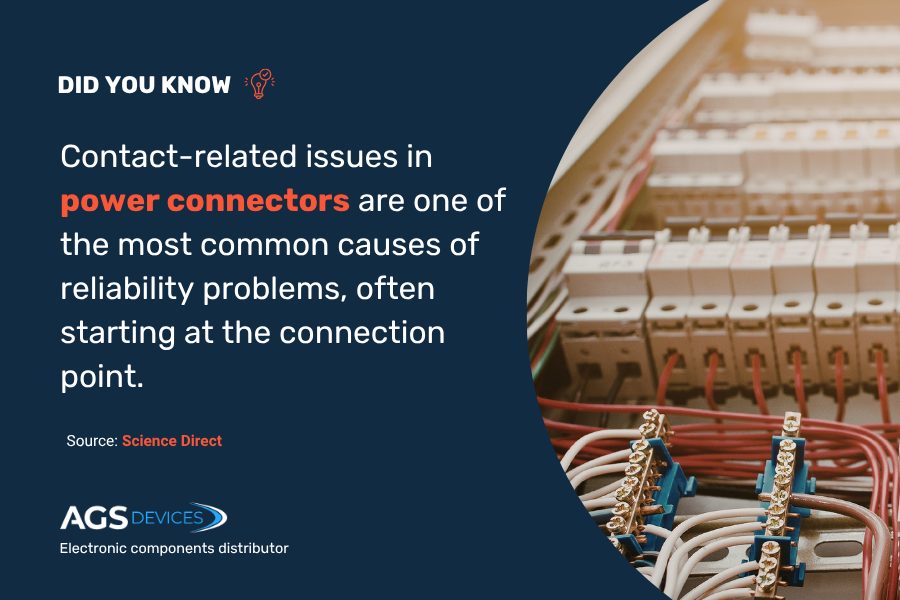
Common Types of Power Connectors
Power connectors come in a range of formats, each designed to handle different levels of current, environmental conditions, and system requirements.
Below, we’ll go through some of the most widely used power connector types and where they typically fit.
IEC Power Connectors (C13, C19, C20)
IEC connectors are among the most common power connectors used in IT infrastructure and industrial systems. You’ll typically see them in servers, data centers, and networking equipment.
They’re standardized globally, which makes them easy to integrate across different regions and systems.
Where they are used extensively:
- Data centers and server racks
- Enterprise IT equipment
- Power distribution units
What to consider: Higher-current versions like C19/C20 are often used in high-load environments, where consistent power delivery is important.
Barrel Connectors (DC Power Jacks)
Barrel connectors are widely used in low-power electronic devices, especially where compact size and simplicity matter.
They are common in:
- Laptops and small electronics
- Power adapters
- Low-voltage devices
What to have in mind: They’re easy to use, but not ideal for high-current applications or environments with movement, as they can loosen over time.
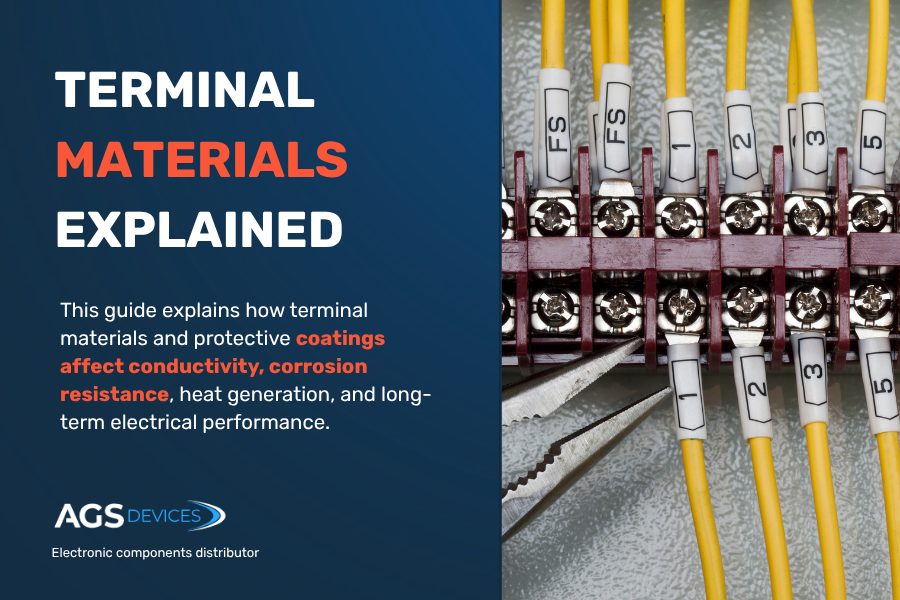
Terminal Blocks
Terminal blocks are used when secure, semi-permanent power connections are needed—especially in industrial and control systems.
They allow wires to be clamped or screwed into place, creating stable and serviceable connections.
You’ll be able to find them in:
- Industrial control panels
- Automation systems
- Power distribution setups
Consider this first: They’re reliable and flexible, but installation quality matters. Poor termination can lead to resistance buildup and heat issues
Anderson Power Connectors
Anderson connectors are designed for high-current applications where durability and repeat connections are required.
They’re often used in environments where connectors need to be connected and disconnected frequently without degrading performance.
You can find them in:
- Battery systems
- Electric vehicles
- Backup power and charging systems
Before deciding consider: They’re built for performance and reliability, especially in demanding environments, but require proper sizing based on current load.
Circular Power Connectors
Circular connectors are built for more demanding environments where vibration, moisture, or exposure are factors.
Their design helps distribute mechanical stress evenly, which improves durability over time.
They work well in industries such as:
- Aerospace and defense
- Industrial equipment
- Outdoor and rugged applications
What to consider: Sealing, locking mechanisms, and material selection play a big role in long-term performance.
Wire-to-Board Power Connectors
These connectors are used to bring power from external wiring into a PCB, making them common in both consumer and industrial electronics.
They help simplify assembly and allow for easier maintenance or replacement.
Where they work well:
- Consumer electronics
- Embedded systems
- Power supply units
What to consider: Retention strength and contact quality are important, especially in systems exposed to movement or repeated use.
Power, Signal, and Data Connectors Explained
Understanding the differences between power, signal, and data connectors is essential for selecting the right component for your system. While they may look similar, each type is engineered for a completely different electrical role.
Power Connectors: High-Current Applications
Power connectors handle higher loads, so heat and stability become the main concern.
These are the connectors you rely on when consistent power delivery matters and where failure can have immediate consequences.
Common examples include IEC cables such as C13, C19, and C20 as well as standard AC plugs and industrial power connectors used in energy and infrastructure systems.
Key characteristics include:
- High current capacity for demanding applications
- Heat-resistant materials to prevent thermal failure
- Secure locking mechanisms for stable connections
Real-world example: Data centers rely on IEC C19/C20 connectors to power high-performance servers, where you need to have consistent energy delivery.
Signal Connectors: Low-Voltage and Control Circuits
Signal connectors operate at much lower power levels, but they require a different kind of precision.
Even small disruptions can affect performance, which makes stability and noise control crucial.
They are commonly found in sensor systems, audio interfaces, and control wiring across industrial and consumer electronics.
Their design prioritizes:
- Noise reduction to prevent interference
- Signal stability for accurate communication
- Precision contacts for consistent performance
Insight: Signal connectors are often the weakest point in system accuracy, even minor interference or degradation can lead to faulty readings or communication errors
Data Connectors: High-Speed Communication Systems
Data connectors deal with speed and that introduces a new level of complexity.
As data rates increase, even small inconsistencies can affect performance, which is why these connectors are engineered with tight control over signal behavior.
Examples include USB, HDMI, Ethernet, and fiber optic connectors, all designed to support fast and reliable data transfer across devices and networks.
Key characteristics include:
- High bandwidth for large data throughput
- Controlled impedance to prevent signal distortion
- Low latency for real-time communication
Real-world example: Modern data centers use connectors capable of supporting 100G to 400G speeds, enabling large-scale cloud and AI infrastructure.
Here’s a simple way to compare how each connector type is typically used in practice:
| Type | Function | Key Priority | Typical Example |
| Power | Power delivery | High current handling | IEC cables, AC plugs |
| Signal | Control signals | Noise reduction and stability | Sensors, control interfaces |
| Data | Digital communication | Speed and signal integrity | USB, Ethernet |
How to Choose the Right Power Connector
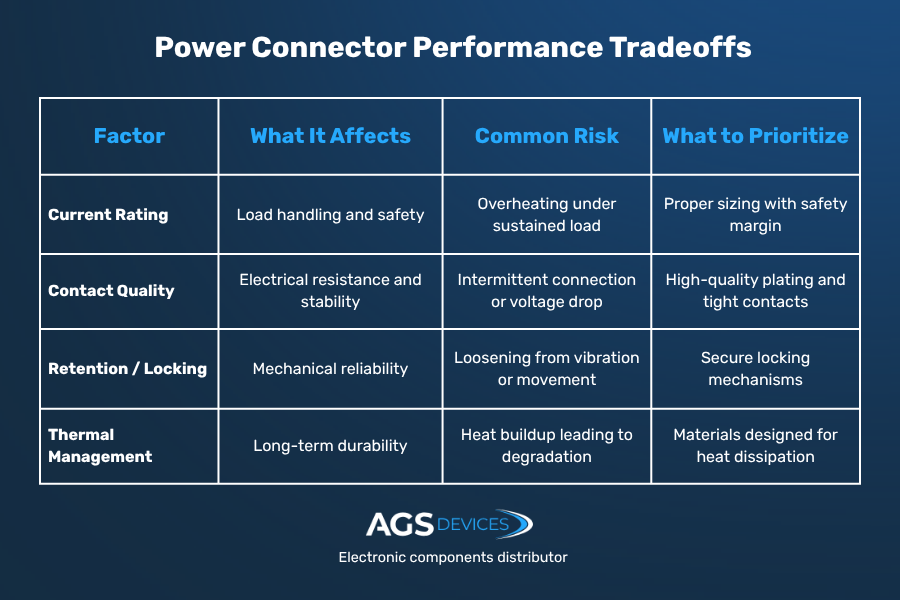
Choosing the right power connector isn’t just about matching specifications. It’s about understanding how that connector will perform in real-world conditions.
A connector that looks suitable on paper can still create issues later if key factors are overlooked early on.
1. Start With the Electrical Load
The first question is simple: How much power does the connector need to handle?
Higher current applications require connectors that can manage heat, maintain stable contact, and operate safely over time.
Undersizing a connector here is one of the most common causes of overheating and failure.
2. Check the Mechanical Fit
Once the electrical requirements are clear, the next step is to make sure the connector fits physically within the system.
This includes:
- Size and available space
- Alignment and ease of connection
- Locking or retention mechanisms
A connector that isn’t secure can loosen over time, especially in systems exposed to movement or repeated use.
3. Consider the Operating Environment
Real-world conditions often matter more than specs.
Heat, vibration, moisture, and dust can all affect how a connector performs over time.
In more demanding environments, choosing connectors with proper sealing, materials, and durability is important.
4. Think Beyond the Component
In practice, connector selection doesn’t stop at performance.
Availability, lead times, and supplier reliability all play a role, especially in production environments where delays can be costly.
That’s why many teams don’t just evaluate connectors; they evaluate how reliably those connectors can be sourced and supported over time.
Reliable Power Connector Solutions Start with AGS Devices
That’s where having the right partner makes a difference.
Choosing the right connector is one part of the process. Making sure you can source it reliably is what keeps projects moving.
At AGS Devices, we support teams that need consistency, traceability, and confidence in their supply chain.
We support your connector sourcing with:
- Global sourcing network: Access to trusted suppliers across key markets
- Hard-to-find components: Including obsolete and allocation-driven connectors
- BOM management: Streamline procurement and reduce overall costs
- Quality assurance: Fully tested and traceable components
- Obsolescence management: Prevent redesigns and supply disruptions
In addition to connectors, we also source electronic components such as:
Power Connector Types: FAQs
What are the different types of power connectors?
Power connector types vary based on how they deliver electricity and where they’re used. Common types include IEC connectors (like C13 and C19), AC plugs, barrel connectors, terminal blocks, and circular connectors.
What is an IEC power connector?
An IEC power connector is a standardized connector used to deliver AC power to electronic devices. Common types include IEC C13, C19, and C20, which are widely used in computers, servers, and industrial equipment.
What is the difference between C19 and C20 connectors?
C19 and C20 connectors are high-power IEC connectors used in data centers and industrial systems. The C19 is typically the female connector, while the C20 is the corresponding male inlet. They are designed to handle higher current loads than standard connectors like C13/C14, making them suitable for high-performance equipment.
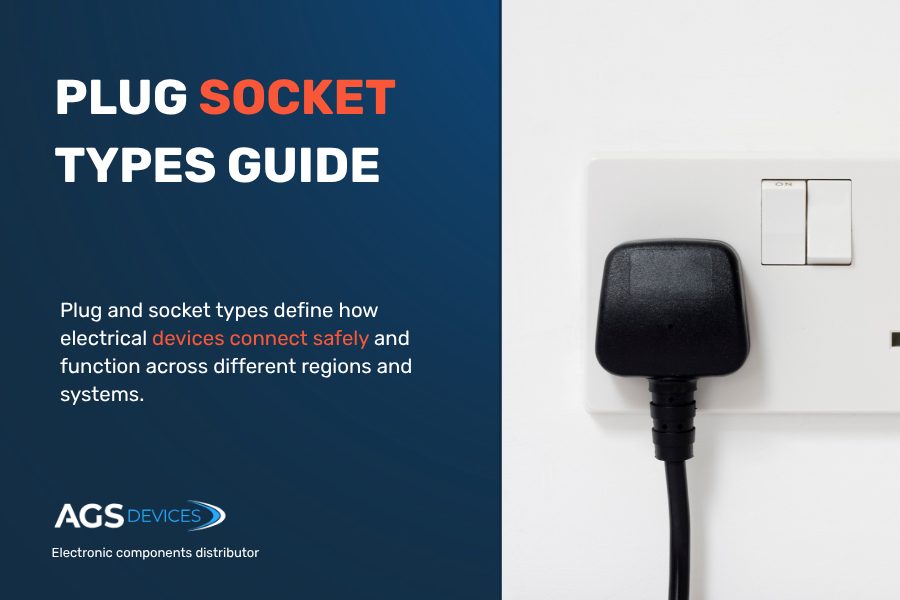
What is an AC plug and how is it used?
An AC plug is a connector used to draw power from a wall outlet into an electronic device. It’s one of the most common types of power connectors and varies by region based on electrical standards. AC plugs are used in everything from household appliances to industrial equipment, often paired with power cords or IEC connectors.
What is a power cord?
A power cord is a cable that carries electrical power from a source to a device. It typically includes connectors on one or both ends, such as an AC plug or IEC connector. Power cords are designed based on voltage, current requirements, and regional standards.
Are there charts for different power connector types?
Yes. Power connector charts are often used to compare connector types based on current rating, application, and compatibility. These charts help engineers and procurement teams quickly identify the right connector for their system requirements. They’re especially useful when working across different standards or environments.
What are common power cable connector names?
Common power connector names include IEC C13, C19, and C20, AC plugs, barrel connectors, terminal blocks, and circular connectors. The naming usually reflects the connector’s standard, shape, or intended use, which helps differentiate between types designed for different applications.