
Crimping vs. Soldering: Key Takeaways
- Crimping and soldering solve different connection challenges: Crimping prioritizes mechanical durability and vibration resistance, while soldering excels in compact, high-conductivity electronic connections
- The application determines the best method: Factors like vibration, environmental exposure, repairability, and production scale all influence which connection method performs best
- Proper technique matters more than the method itself: Poor crimps and weak solder joints can both increase resistance, heat buildup, and long-term failure risk
- Reliable connections start with quality components: Using the right terminals, tools, and sourcing partners improves electrical performance, maintenance efficiency, and long-term system reliability
In electrical systems, the reliability of a connection often matters more than the wire itself. A poorly executed crimp or solder joint can increase resistance, generate heat, and eventually lead to intermittent failures that are difficult to diagnose.
That’s why the debate around crimping vs soldering continues across industries like automotive, aerospace, industrial automation, and electronics manufacturing. Both methods are designed to create secure electrical connections, but they achieve that goal in very different ways.
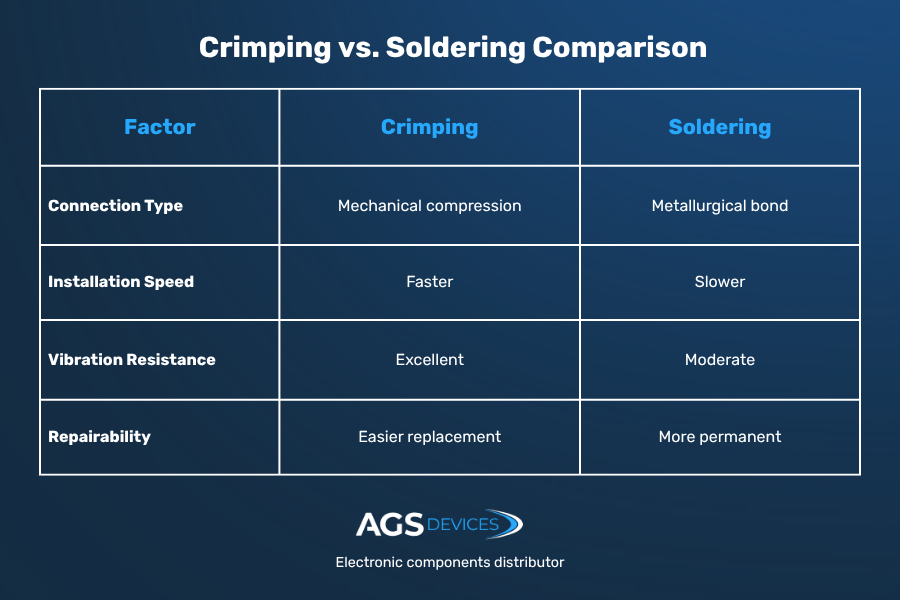
Crimping uses mechanical compression to secure conductors, making connections that are highly resistant to vibration and ideal for large-scale production. Soldering, on the other hand, creates a metallurgical bond that is widely used in PCB assembly and precision electronics.
In this guide, we’ll cover:
- How crimping and soldering work
- The key differences between both methods
- Advantages and disadvantages of each approach
- Common applications across industries
- How to choose the right connection method for your system
Crimping and Soldering: What’s the Difference?
Both crimping and soldering are designed to create secure electrical connections, but they achieve that connection in very different ways.
How Does Crimping Create an Electrical Connection?
Crimping creates a connection through mechanical compression. A crimping tool compresses the terminal around the wire, forming a tight bond that secures the conductor both physically and electrically.
When done correctly, crimping creates:
- A gas-tight connection
- Strong mechanical retention
- Low electrical resistance
You’ll usually find crimped connections in systems exposed to vibration or repeated movement.
In practice, crimping is usually chosen because it offers:
- Faster installation speed
- Excellent vibration resistance
- Consistent performance in large-scale manufacturing
What Happens During the Soldering Process?
Soldering creates a metallurgical bond by melting solder alloy around conductors, permanently joining them together. This method is commonly used in PCB assembly and precision electronics where compact, highly conductive connections are required.
The solder flows between the conductors and solidifies, creating electrical continuity and mechanical bonding.
Soldering is valued for:
- Strong electrical conductivity
- Compact connection points
- Precision in electronic assemblies
However, soldering also requires careful heat control and proper technique to avoid weak joints or damage to nearby components.
What Do Both Methods Have in Common?
Even though the processes are different, both methods aim to:
- Create reliable electrical continuity
- Secure conductors mechanically
- Minimize resistance and signal loss
Both approaches also depend heavily on proper tools, materials, and installation quality. A poor crimp or weak solder joint can increase resistance, generate heat, and reduce long-term reliability.
Is Crimping Better Than Soldering?
Neither method is automatically better. The environment and operating conditions usually determine the better fit.
When Crimping Is the Better Choice
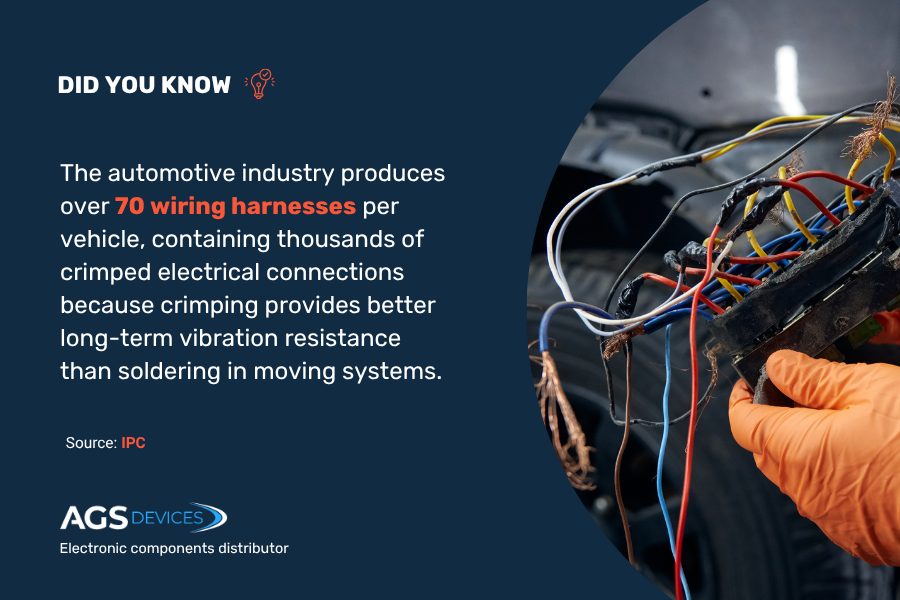
Crimping is typically preferred in applications where mechanical reliability and vibration resistance are critical. A properly executed crimp creates a strong mechanical bond that performs well under movement, stress, and repeated use.
Crimping is often the better option when:
- Vibration resistance matters
- Faster assembly and production efficiency are needed
- Maintenance accessibility and easier replacement are important
This is why crimped connections are widely used in automotive wiring harnesses, aerospace systems, and industrial machinery.
When Soldering Has the Advantage
Soldering is often the better solution in compact electronic assemblies where precise, permanent conductive joints are required. It allows connections to be made in smaller spaces while maintaining strong electrical continuity.
Soldering may be preferred when:
- Space is limited
- PCB assembly is required
- Permanent compact joints are needed
That’s why soldering remains common in PCB assembly and compact electronic systems.
How Crimping and Soldering Work in Real Applications
Although crimping and soldering are both designed to create reliable electrical connections, they achieve that connection in very different ways.
How Crimping Works
Crimping creates a connection through a mechanical compression process. A crimping tool deforms the terminal around the wire, compressing the conductors tightly enough to form both electrical continuity and mechanical retention.
When properly executed, a crimped connection creates a gas-tight seal that helps prevent oxidation and minimizes electrical resistance. This is one of the main reasons crimping is widely used in automotive, aerospace, and industrial systems where reliability under movement and vibration is critical.
A well-executed crimp offers several important advantages. It allows for fast installation, delivers strong vibration resistance, and provides highly consistent results in large-scale manufacturing environments.
Crimped connections are commonly used in:
- Automotive wiring harnesses
- Aerospace electrical systems
- Industrial control equipment
However, crimping depends heavily on using the correct tools and techniques. An improperly crimped terminal can create weak contact pressure, increasing resistance and heat buildup over time.
In vibration-heavy systems like automotive wiring, crimped connections are generally preferred because they maintain mechanical stability more effectively over time.
How Soldering Works
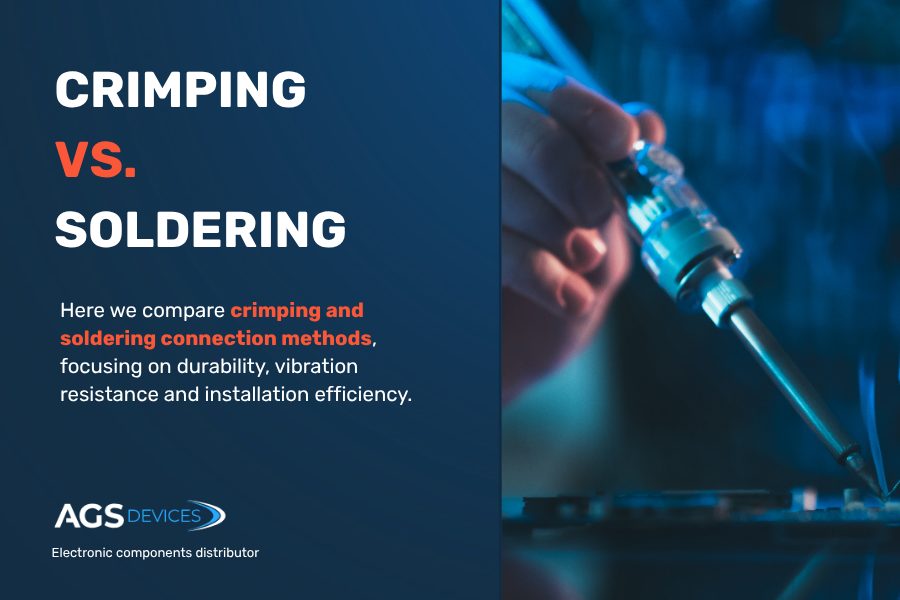
Soldering creates a connection using molten solder alloy to bond conductors together. Heat is applied to the wire and terminal or component, allowing solder to flow into the joint before cooling into a conductive bond.
Because soldering creates compact and highly conductive connections, it is widely used in electronics manufacturing and PCB assembly where space is limited and precision matters.
Soldering is especially valued for its strong conductivity and ability to create clean, compact connection points in dense electronic assemblies. This makes it ideal for applications such as:
- PCB assembly
- Electronics repair
- Consumer electronic devices
At the same time, soldering requires greater operator control and precision. Excessive heat, poor solder distribution, or improper wetting can weaken the connection instead of improving it.
Compared to crimping, soldered joints are generally more sensitive to vibration and repeated thermal expansion cycles, which can eventually stress the joint in demanding environments.
How Can AGS Devices Help You Build More Reliable Electrical Connections?
Choosing between crimping and soldering is not simply a matter of preference. It’s about matching the connection method to the real-world demands of the application.
Factors like vibration, temperature changes, maintenance access, and production requirements all influence which approach will deliver the most reliable long-term performance.
At AGS Devices, we help engineers, manufacturers, and procurement teams source the components needed to build dependable electrical connections across industrial, automotive, aerospace, and electronic systems.
AGS Devices supports your sourcing needs with:
- Global sourcing network: Access to trusted manufacturers and suppliers worldwide
- Certified components: Quality-tested and fully traceable parts
- Hard-to-find products: Including obsolete and allocation-constrained components
- BOM optimization: Reduce sourcing complexity and improve procurement efficiency
- Quality assurance: Components selected for reliability and long-term performance
Whether your application requires the vibration resistance of crimping or the precision of soldering, AGS Devices helps ensure you have the right components to support safe, stable, and reliable electrical connections.
Crimping vs Soldering: FAQs
What is the difference between crimping and soldering?
Crimping creates an electrical connection through mechanical compression, while soldering uses molten solder alloy to bond conductors together. Crimping is typically preferred for vibration resistance, while soldering is commonly used in PCB and precision electronics assembly.
Is crimping better than soldering?
Crimping is often better in high-vibration environments such as automotive and industrial systems because properly executed crimps provide strong mechanical retention and durability. However, soldering may be better for compact electronic assemblies and PCB connections.
Is soldering better than crimping for electrical connections?
Soldering can provide excellent conductivity and compact connection points, making it ideal for electronics manufacturing and repair. The better method depends on the application, environmental conditions, and mechanical stress requirements.
Why do automotive systems use crimped connections?
Automotive systems commonly use crimped connections because they perform well under vibration, temperature changes, and mechanical stress. Properly crimped terminals are highly reliable in moving and high-vibration environments.
Is soldering stronger than crimping?
Mechanically, crimped connections are often stronger in vibration-heavy applications. Soldered joints can become brittle under repeated movement or thermal cycling, while properly crimped connections maintain flexibility and mechanical stability.
What are the advantages of crimping?
Crimping offers fast installation, excellent vibration resistance, strong mechanical retention, and consistent results in large-scale manufacturing. It is widely used in automotive, aerospace, and industrial wiring systems.
What are the advantages of soldering?
Soldering provides strong electrical conductivity and compact connection points. It is commonly used in PCB assembly, electronics repair, and precision electronic applications where space is limited.
What causes crimp or solder connection failure?
Connection failures are often caused by poor technique, incorrect tooling, insufficient contact pressure, excessive heat, or environmental stress. These issues can increase resistance, generate heat, and reduce long-term reliability.
When should you use crimping instead of soldering?
Crimping is typically preferred when vibration resistance, production speed, and easier maintenance are important. It is ideal for wiring harnesses, industrial systems, and field-service applications.
How does AGS Devices support connector and terminal sourcing?
AGS Devices helps customers source reliable terminals, connectors, and interconnect components through a global supplier network, supporting industries that require high-performance electrical connection solutions.
Can AGS Devices source hard-to-find crimp terminals and connection components?
Yes, AGS Devices specializes in sourcing hard-to-find, obsolete, and allocation-constrained terminals, connectors, and electrical interconnect components for industrial and electronic applications.