
Types of Connectors: Key Takeaways
- Connector types shape how a system performs, whether it’s power delivery, signal clarity, or high-frequency communication
- The right choice depends on your application, environment, and long-term reliability requirements, not just specs on paper
- Design details like materials, structure, and fit directly influence how connectors hold up under real-world conditions
- Reliable sourcing matters just as much as selection, working with a trusted partner helps reduce risk and avoid costly disruptions
In complex systems like vehicles, data centers, or industrial equipment, connectors aren’t just supporting components. They’re everywhere, and they quietly determine how well everything works together.
When the right types are used, systems run smoothly. When they’re not, issues tend to show up later and usually at the worst time.
Each one is built for a specific role, whether that’s handling power, carrying sensitive signals, or maintaining performance in demanding environments.
For engineers, connector choice shows up in performance, signal quality, heat, and long-term reliability. For procurement teams, it’s just as critical. Availability, lifecycle risk, and supplier reliability all come into play.
In both cases, getting it wrong doesn’t just cause small issues, it can lead to delays, rework, or even system failure.
In this guide, we’ll cover:
- Different types of connectors and their roles
- Power, signal, and RF connector categories
- Board-level and system-level connections
- Key design and performance differences
- Real-world applications across industries
- How to choose the right connector for your system
Electronic Connectors: Key Facts and Classification
The easiest way to understand connectors is to look at how they function within a system.
They act as the link between components, moving power, carrying signals, and keeping everything connected as one system.
There are a few ways to group connectors, depending on what you’re focusing on.
Some are defined by what they carry: power, signal, or high-frequency data. Others are based on how they physically connect components, whether that’s board-level, cable-based, or panel-mounted designs.
At a high level, the main connector categories include:
- Power connectors: Designed for high current delivery and thermal stability
- Signal connectors: Used for data and communication between components
- RF connectors: Built for high-frequency signals with minimal loss
- Board connectors: Enable internal connections within electronic assemblies
Each classification serves a distinct purpose, but they all contribute to the same goal, ensuring reliable electrical continuity across a system.
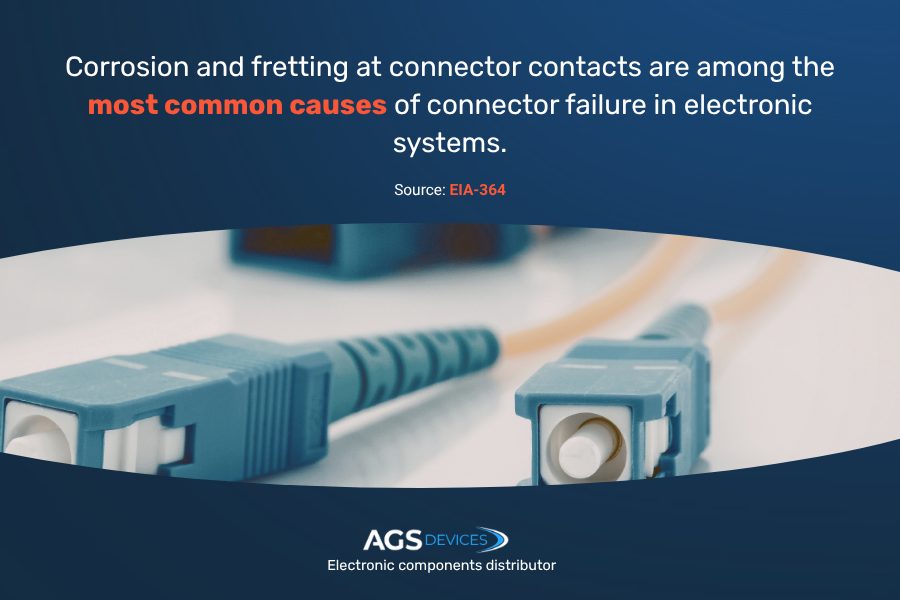
Power, Signal, and RF Connectors: Key Types Explained
Connectors in electronic systems are primarily defined by the type of electrical load they handle, whether it’s power delivery, signal transmission, or high-frequency communication.
Each category is engineered with specific performance priorities, and choosing the right type is critical for system stability and efficiency.
Power Connectors: Built for High Current and Reliability
Power connectors are built to handle higher loads, so stability and heat management become the priority.
These are the connectors you rely on when consistent power delivery really matters, and where failure isn’t an option.
Common examples include AC/DC plugs, battery connectors, and terminal blocks used in industrial and energy systems.
Key characteristics:
- High current capacity to support demanding loads
- Heat-resistant materials to prevent thermal failure
- Secure locking mechanisms to ensure stable connections
Real-world example: In electric vehicles (EVs), charging connectors are engineered to handle hundreds of amps, requiring precise thermal management and robust contact design to ensure safe operation.
Signal Connectors: Precision for Data and Communication
Signal connectors deal with something different: precision.
Even small disruptions can affect performance, which is why these connectors are designed to keep data clean, stable, and free from interference.
Examples include RJ45 (Ethernet), audio connectors, and sensor interfaces commonly found in industrial and consumer systems.
These connectors are designed with:
- Shielding to minimize electromagnetic interference
- Precision contacts for stable, low-resistance connections
- Noise reduction features to preserve signal clarity
Insight: Even small levels of signal degradation can lead to data errors, reduced accuracy, or communication failures, especially in high-speed or sensitive systems.
RF and Coaxial Connectors: High-Frequency Performance
RF connectors operate in a space where small imperfections make a big difference.
At higher frequencies, even minor inconsistencies can lead to signal loss or reflection, so these connectors are built with much tighter control.
Common types include SMA, BNC, and N-type connectors, each designed for specific frequency ranges and applications.
Key features:
- Controlled impedance to ensure consistent signal propagation
- Shielding to protect against EMI and external interference
- Low signal loss for high-frequency efficiency
Did you know? RF connectors must maintain a consistent impedance, typically 50Ω, to prevent signal reflections, which can degrade performance in applications like 5G networks, radar systems, and satellite communications.
| Connector type | Function | Key benefit | Typical use case |
| Power | Power delivery | High current handling | Power supplies, EV systems |
| Signal | Data transmission | Precision and low noise | Sensors, communication systems |
| RF | High-frequency signals | Low loss and controlled impedance | Telecom, aerospace |
| Board-to-Board | PCB connection | Compact, high-density design | Smartphones, embedded systems |
| Circular | Rugged connections | Durability and environmental sealing | Aerospace, industrial |
Circular vs Rectangular Connectors: Design Differences That Matter
Connector shape might seem like a simple detail, but it has a real impact on performance and durability.
In practice, choosing between circular and rectangular designs often comes down to environment, space, and how the connection will be used over time.
Circular Connectors
Circular connectors are known for their rugged, sealed construction, making them ideal for harsh and demanding environments. Their round design allows for even distribution of mechanical stress, which improves resistance to vibration and physical impact.
They are commonly used in:
- Aerospace and defense systems
- Industrial machinery
- Outdoor and high-moisture environments
These connectors often include sealing features such as gaskets or O-rings, helping protect against dust, water, and contaminants.
Rectangular Connectors
Rectangular connectors are designed for high pin density and efficient space utilization. Their shape allows for more contacts in a compact footprint, making them ideal for data-intensive and high-density applications.
They are widely used in:
- Data centers and communication systems
- Industrial automation equipment
- Consumer and computing electronics
Their structured layout also simplifies alignment and integration in PCB and modular systems.
Simplify Connector Sourcing with AGS Devices
Choosing the right connector is one part of the equation, sourcing it reliably is what keeps your production moving.
That’s where having the right partner matters.
At AGS Devices, we work with teams that need consistency, traceability, and confidence in every component they source.
We support your connector sourcing with:
- Global sourcing network: Access to trusted suppliers across the U.S., Europe, and Asia
- Hard-to-find components: Including obsolete and allocation-driven connectors
- BOM optimization: Reduce costs and streamline procurement
- Quality assurance: Fully tested, traceable components meeting industry standards
- Obsolescence management: Avoid redesigns and production delays
In addition to connectors, we also source electronic components such as:
Whether you’re building systems for automotive, aerospace, industrial automation, or consumer electronics, AGS Devices helps you secure connectors that meet both performance and supply chain demands.
Types of Connectors: FAQs
What are the different types of connectors in electronics?
The main types of connectors in electronics include power connectors, signal connectors, RF (radio frequency) connectors, board-to-board connectors, wire-to-board connectors, and circular or rectangular connectors. Each type is designed for a specific function, such as delivering power, transmitting data, or supporting high-frequency communication.
What are electronic connectors used for?
Electronic connectors are used to join circuits and enable the transfer of electrical signals and power between components. They allow systems to be modular, serviceable, and scalable across applications like consumer electronics, automotive systems, and industrial equipment.
What is the difference between power and signal connectors?
Power connectors are designed to carry higher current and voltage, focusing on thermal performance and safety. Signal connectors, on the other hand, handle low-power data transmission and prioritize signal integrity, noise reduction, and precision.
What are RF connectors used for?
RF connectors are used for high-frequency signal transmission in applications such as telecommunications, aerospace, and wireless systems. They are designed to maintain controlled impedance and minimize signal loss, which is critical for reliable communication.
What are board-to-board connectors used for?
Board-to-board connectors are used to connect printed circuit boards directly without cables. They are commonly found in compact electronic devices like smartphones and embedded systems, where space-saving and high-density design are important.
How do I choose the right connector type?
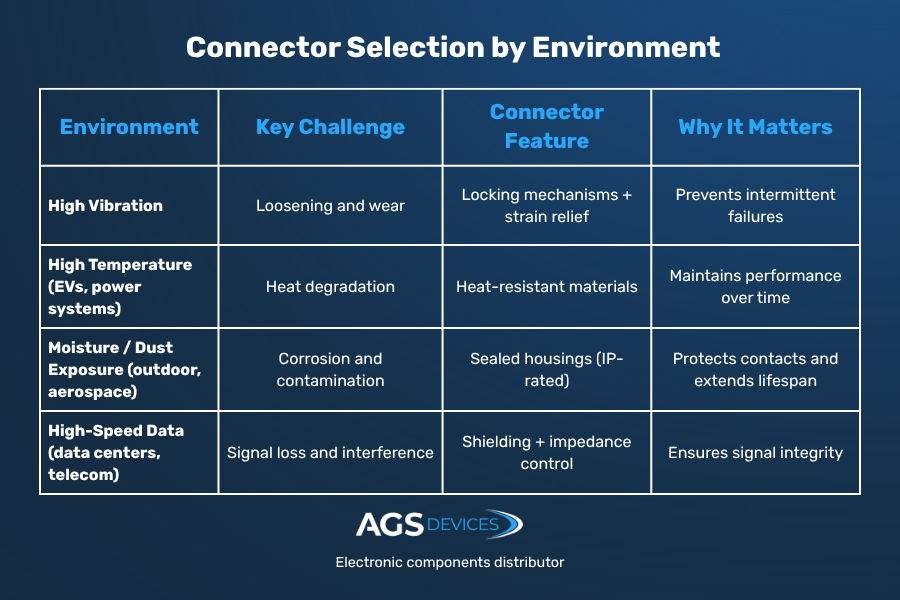
Choosing the right connector depends on your electrical requirements, mechanical constraints, and operating environment. Factors like current rating, signal type, durability, and exposure to heat or vibration all influence the best choice for your application.
How does AGS Devices help with connector sourcing?
AGS Devices supports connector sourcing through a global network of trusted suppliers, ensuring access to high-quality and hard-to-find components. Their team helps reduce lead times, manage risk, and maintain consistent supply for critical applications.
Can AGS Devices help with connector selection and BOM management?
Yes, AGS Devices works with engineering and procurement teams to assist in connector selection based on application requirements. They also provide BOM optimization services to improve sourcing efficiency, reduce costs, and prevent component shortages.