
Automotive Electronics: Key Takeaways
- A modern vehicle relies on over 1,000 chips, and electronics now make up 35 to 40% of a high-end car’s cost
- Automotive parts must survive brutal conditions (roughly -40°C to 150°C, constant vibration) and service lives spanning 10 to 20 years.
- Automotive-grade qualification (AEC-Q), quality systems (IATF 16949) and functional safety (ISO 26262) set the bar your supplier must support
- The 2021 chip shortage showed how a single missing part can halt production lines and cost billions
The cost of a bad component decision in automotive is measurable: OEMs paid roughly $51 billion in warranty claims in 2023, close to 2% of revenue.
That’s the stakes behind every sourcing decision in this sector, and it’s why your choice of automotive electronics supplier is now a strategic call, not a purchasing afterthought.
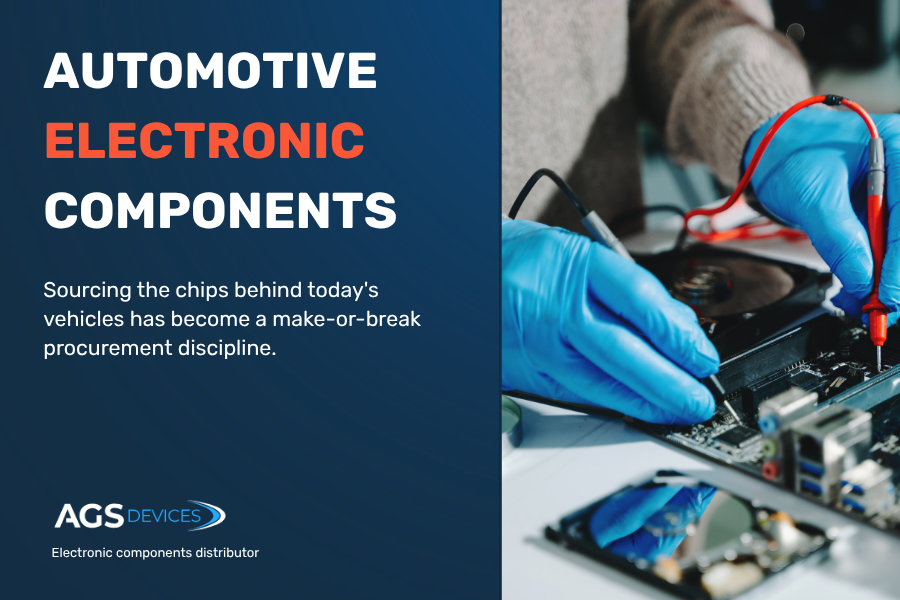
Automotive parts have to survive heat, vibration and service lives of up to 20 years while meeting some of the toughest quality standards in any industry.
This guide breaks down both halves of the problem: the sourcing challenges that make automotive components uniquely hard to secure and how to pick a supplier who can actually deliver under those conditions. ž
What Counts as an Automotive Electronic Component?
Automotive electronic components are the parts that sense, compute, power and connect everything in a modern vehicle. They run from the obvious to the invisible, and today car electric components touch nearly every system on board:
- Electronic control units (ECUs) and microcontrollers: the brains managing the engine, braking, steering and dozens of other functions
- Sensors: measuring everything from wheel speed and pressure to the radar and cameras behind ADAS
- Power electronics: regulators, converters, IGBTs and MOSFETs that move energy, especially in EV powertrains
- Connectors and wiring harnesses: the nervous system tying it all together, where a single bad contact can cause dangerous intermittent faults
- Batteries and power management: the backbone of both conventional and electrified vehicles
The shift to electrification and autonomy is pushing this trend sharply upward. As vehicles consolidate dozens of ECUs into zonal architectures and software-defined platforms, silicon content per car keeps climbing, which only raises the sourcing stakes.
Why Your Automotive Electronics Supplier Choice Matters
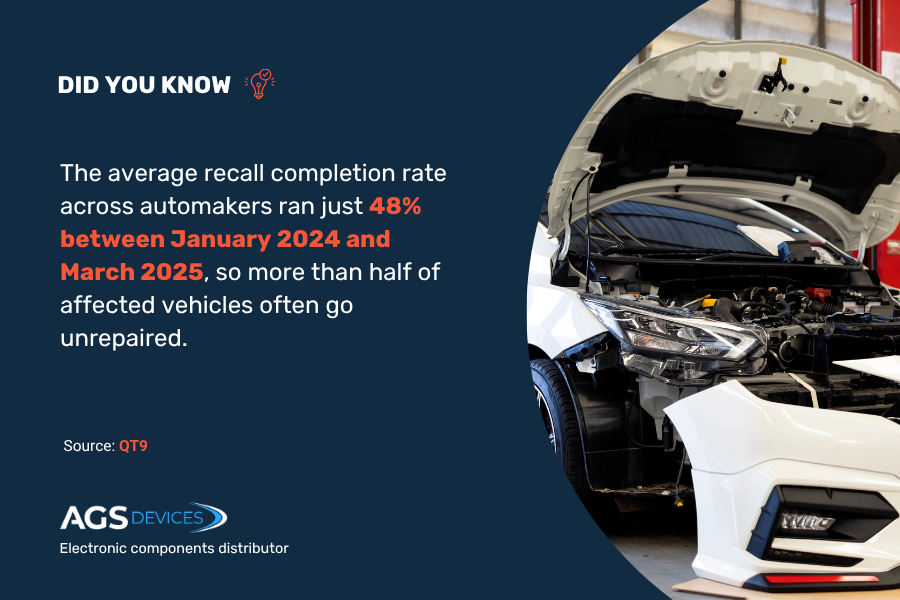
Pick the wrong automotive electronics supplier and the failure rarely shows up at the loading dock. It shows up months later as a field failure, a warranty claim, or a recall.
A useful rule of thumb from the field: shaving 50 cents off a part isn’t worth risking a multimillion-dollar recall.
Because automotive parts sit inside safety-critical systems with long lives, the supplier you choose is effectively underwriting your quality, your timelines and your compliance. That’s a lot to hand to whoever had the cheapest stock that week.
Why Sourcing Automotive Electronic Components Is So Hard
Automotive sourcing carries pressures most other sectors never see at once. Understanding them is the first step to managing them.
- The shortage hangover: The 2021-2023 crunch exposed how fragile just-in-time supply is, and mature process nodes (the 28 to 45 nm range that runs most car chips) still see lead times north of 40 weeks at times, per industry analysis
- Allocation and long lead times: When demand outruns capacity, automakers and Tier 1 suppliers compete for the same constrained parts
- A brutal operating environment: Under-hood temperatures can swing from -40°C to 150°C, with constant vibration and moisture that consumer parts would never survive
- Long lifecycles versus short part lives: Vehicles stay in service 10 to 20 years, far longer than the components inside them stay in production, so obsolescence is a constant
- Zero-defect expectations: The industry measures defects in parts per million, which leaves no room for a marginal part or an unverified source
- Rising content, rising exposure: More chips per car means more parts with the potential to stop the line
Pro tip: Map your highest-risk automotive parts now, the single-sourced and allocation-prone ones, and line up a second source before you need it. The worst time to qualify a backup is when the line’s already down.
Automotive-Grade Standards Every Supplier Should Know
“Automotive-grade” isn’t marketing, it’s a stack of specific qualifications. A credible supplier understands what each one means and can supply parts and documentation to match.
1. AEC-Q: Component Qualification
The Automotive Electronics Council’s AEC-Q standards represent the reliability benchmark for automotive parts. AEC-Q100 covers integrated circuits, AEC-Q101 covers discrete semiconductors, and AEC-Q200 covers passives. Only parts that pass AEC’s stress-test qualification are considered automotive-grade and fit for safety-critical use.
Pro tip: An AEC-Q part number isn’t proof on its own. Ask for the qualification report and the AEC-Q grade, because Grade 0 (-40 to 150°C) and Grade 1 (-40 to 125°C) aren’t interchangeable, and dropping a Grade 1 part into an underhood spot is a field failure waiting to happen.
2. IATF 16949: Quality Management
IATF 16949:2016 is the automotive industry’s quality management standard. It replaced ISO/TS 16949 and emphasizes defect prevention and reduced variation. One nuance worth knowing: Distributors can’t actually hold IATF 16949 certification themselves, so look instead for a distributor whose ISO 9001 system, supplier controls and traceability support your IATF 16949 obligations.
3. ISO 26262: Functional Safety
ISO 26262 governs the functional safety of automotive electrical and electronic systems. It defines Automotive Safety Integrity Levels from ASIL-A (lowest) to ASIL-D (highest), classifying how much rigor a component and its surrounding design need based on risk.
For example, an interior ambient light might sit at ASIL-A or below, while the electronic power steering and braking systems land at ASIL-D, the most demanding level. The higher the ASIL, the more evidence you need that every component in that path was developed and verified to match.
4. Environmental and Cybersecurity Standards
Beyond the big three, parts are often validated to ISO 16750 for thermal cycling and vibration, and connected vehicles now bring cybersecurity rules like UN R155 and ISO/SAE 21434 into the picture. Your supplier should recognize which of these are relevant to your application.
Pro tip: Match the standard to where the part actually lives. A roof-mounted antenna module and a transmission-mounted sensor face completely different thermal, vibration and moisture loads, so don’t accept one blanket “automotive-grade” claim for parts in very different environments.
How To Choose an Automotive Electronics Supplier
Supplier selection is where the strategy gets real. Vet any automotive electronics supplier against this checklist before you commit:
- Quality system and certifications: ISO 9001:2015 at minimum, ideally with AS9120B and inspection standards like IDEA-STD-1010-B for counterfeit avoidance
- Traceability: certificates of conformance and a documented chain of custody back to the manufacturer or authorized channel
- Access to automotive-grade parts: the ability to source AEC-Q qualified components and provide the supporting documentation
- In-house inspection and testing: real verification capability, not just resale
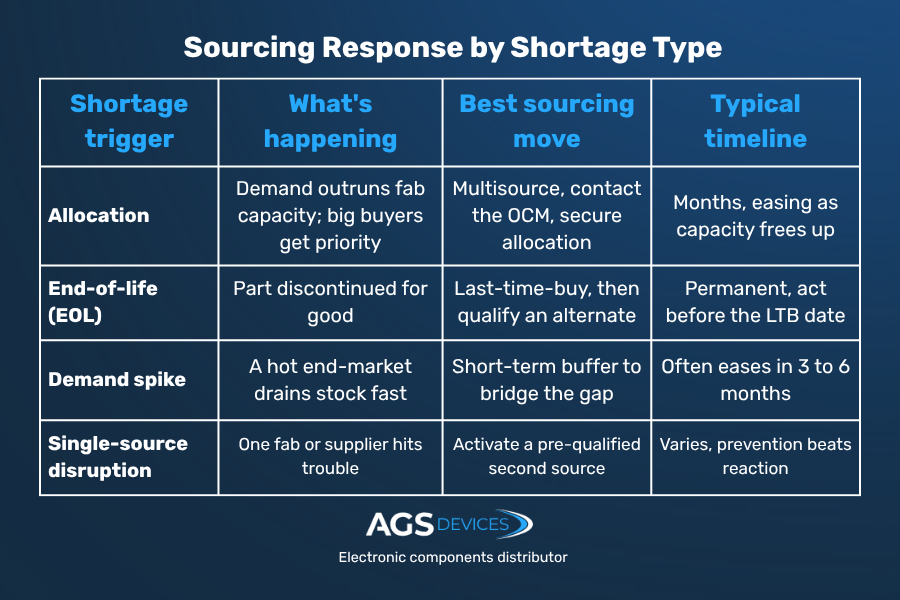
- Lifecycle and obsolescence support: help with last-time-buys, alternates and long-term availability planning
- Responsiveness under pressure: fast RFQ turnaround and real stock visibility when a line is at risk
Pro tip: Ask a prospective supplier how they’d handle an AEC-Q qualified part going obsolete mid-program. A strong partner will talk through last-time-buys, qualified alternates and documentation. A weak one will just promise to “find something.”
Avoiding Counterfeit Automotive Components
In a safety-critical vehicle system, a counterfeit part isn’t a cost problem, it’s a liability problem. And the risk is rising: Counterfeit and nonconforming part reports hit a nine-year high in 2024, with 1,055 suspect parts logged, a 25% jump over 2023, according to the ERAI 2024 Annual Report. Fakes often pass a casual check and fail later in the field, which can mean an automotive safety system that doesn’t work when it’s needed.
Protect yourself with layered verification:
- Documentation review: Cross-check part, lot and date codes against the certificate of conformance and packaging
- Visual inspection to a recognized standard: IDEA-STD-1010-B and similar protocols catch resurfacing, remarking and altered date codes
- X-ray and electrical testing: Confirm internal structure and performance against a known-good reference when risk warrants
- Source discipline: Buy from documented, certified suppliers and treat suspiciously cheap shortage-era offers as a warning sign
Managing Obsolescence Over an Extended Vehicle Life
Because vehicles outlive their components, obsolescence isn’t a rare event, it’s a program-long reality. A part you designed in today may hit end-of-life long before the platform retires.
You’ve got a few moves to stay ahead:
- Last-time-buy: Secure enough qualified stock to cover remaining production and service, then store it properly.
- Qualify alternates early: When a swap is unavoidable, validate it fully, since our guide to choosing alternative electronic parts walks through matching and re-qualification.
- Build a sourcing process: For parts already scarce, a structured approach beats panic buying, which is the focus of our guide on sourcing hard-to-find components.
We’ve seen automotive customers tempted to shave cents per unit with a non-qualified part, only to face the far bigger cost of a field failure down the road. The cheap part is rarely the cheap decision.
A Quick Checklist for Choosing an Automotive Electronics Supplier
When you’re evaluating a supplier or sourcing a critical part, run this sequence:
- Confirm the part’s automotive-grade qualification (AEC-Q) and operating ratings
- Verify the supplier’s quality system, certifications and traceability
- Ensure that documentation (CoC, RoHS, REACH) comes standard, not on request
- Assess lifecycle status and get an obsolescence plan in place
- Verify authenticity to a recognized inspection standard
- Confirm the supplier can move fast when a line is at risk
Why AGS Devices Is a Trusted Automotive Electronics Supplier
AGS Devices is an automotive electronics supplier with nearly two decades in the sector and a quality program built for it. Here’s what the team brings:
- Industry-certified quality assurance, adhering to ISO 9001:2015, AS9120B and IDEA-STD-1010-B inspection standards
- A broad range of automotive electronic components, from ECUs and sensors to power devices, connectors and wiring harnesses
- A vast inventory and rapid fulfillment built for just-in-time automotive manufacturing
We also support your full component sourcing needs, offering:
Automotive Electronic Components: FAQs
Here are the questions engineers and buyers ask us most often when choosing an automotive electronics supplier.
What are automotive electronic components?
They’re the electronic parts inside a vehicle, including ECUs, microcontrollers, sensors, power electronics, connectors and wiring harnesses. What sets them apart is the demand: They must survive extreme temperatures, vibration and long service lives while meeting strict automotive quality and safety standards.
What does “automotive-grade” mean?
Automotive-grade means a component has passed qualification proving it can handle a vehicle’s harsh environment and reliability demands. The key benchmark is the AEC-Q series: AEC-Q100 for ICs, AEC-Q101 for discretes and AEC-Q200 for passives.
What standards should an automotive electronics supplier meet?
Look for ISO 9001 quality management, plus access to AEC-Q qualified parts and support for your IATF 16949 and ISO 26262 obligations. Certifications like AS9120B and inspection standards such as IDEA-STD-1010-B signal strong counterfeit controls.
Why are automotive components more expensive than consumer parts?
Automotive-grade components typically cost two to three times their industrial equivalents because of qualification and reliability requirements. They undergo extensive stress testing, must perform across a wide temperature range, and carry longer availability commitments.
How did the chip shortage affect automotive sourcing?
The 2021-2023 shortage halted production lines worldwide and cost the auto industry an estimated $210 billion in lost revenue in 2021 alone, according to AlixPartners. It exposed the fragility of just-in-time sourcing and pushed automakers toward multisourcing, buffer stock and closer supplier relationships.
How do I avoid counterfeit automotive components?
Buy only from certified, documented suppliers, and require traceability and certificates of conformance. Insist on inspection to recognized standards like IDEA-STD-1010-B, with X-ray and electrical testing where the risk warrants.
What are ISO 26262 and ASIL?
ISO 26262 is the functional safety standard for automotive electrical and electronic systems. It defines Automotive Safety Integrity Levels from ASIL-A (lowest risk) to ASIL-D (highest), which determine how rigorously a component and its surrounding design must be developed and verified.
How do I handle an automotive part going obsolete?
First confirm the end-of-life status, then weigh a last-time-buy of qualified stock against qualifying an alternate. Because automotive parts are validated to strict standards, a last-time-buy often protects your program best in the near term.
Should I single-source or multisource automotive components?
Multisourcing is the safer strategy for critical parts. Relying on a single supplier leaves you exposed to allocation, disruptions and discontinuations, as the chip shortage made painfully clear. Qualifying a second source in advance requires upfront effort but protects your production line when supply tightens.
How does AGS Devices support automotive manufacturers?
AGS Devices sources, inspects and verifies automotive electronic components to strict quality standards, adhering to ISO 9001:2015, AS9120B and IDEA-STD-1010-B. The team also helps with shortages and obsolescence, including last-time-buy support and qualified alternates. With a deep inventory and 24/7 technical support, AGS helps keep automotive production on schedule.