
Sourcing Hard-to-Find Parts: Key Takeaways
- Before you source anything, confirm that the part is truly unavailable and not just back-ordered, because the fix is different for each
- The root cause (allocation, EOL, single-source or demand spike) determines which sourcing channel will work
- Authorized distribution comes first, with independent and specialized distributors filling the gap for obsolete and rare parts
- Counterfeit reports hit a nine-year high in 2024, so verification and traceability are non-negotiable once you leave authorized channels
A single missing part can stop an entire production run, and right now the parts going scarce aren’t just the old ones.
In 2026, MOSFET and IGBT lead times have stretched past 30 weeks as AI data center demand pulls wafer capacity away from general-purpose production, according to industry reporting.
So sourcing hard to find parts has become a core procurement skill, not an occasional fire drill. The good news is that a repeatable process beats panic buying every time.
This guide walks you through it: diagnose why the part’s scarce, pick the right channel, verify what you buy, and plan so it doesn’t happen again. It’s written for the buyers and engineers who have to keep the line moving.
Why Electronic Components Become Hard to Find
Knowing why a part went scarce tells you how to get it back. The reasons cluster into a handful of patterns, and each one points to a different sourcing play:
- Allocation and capacity crunches: When demand outruns fab capacity, manufacturers prioritize their highest-volume customers, and mid-tier buyers get reduced allocations or longer lead times
- End-of-life and discontinuation: Once a part is EOL, demand spikes as everyone rushes the remaining stock
- Single-source dependence: If one manufacturer makes the part, a single disruption (a fab issue, a trade restriction, a natural disaster) creates an instant crisis with no fallback
- Demand spikes: A sudden design win or a hot end-market can drain stock faster than anyone forecast
The market backdrop makes all of this worse before it gets better. The global electronic components market is projected to reach roughly $224.84 billion in 2025, and that scale brings more parts, shorter lifecycles and more chances for any one of them to slip out of reach.

A Repeatable Step-by-Step Workflow for Sourcing Hard-to-Find Parts
When a part goes dark, the temptation is to start emailing brokers. Try to resist it. A structured workflow finds the part faster and keeps a counterfeit out of your build.
Go through this workflow if you have any doubts:
Step 1: Confirm It’s Unavailable
Before you spend a day sourcing, make sure you have a real shortage and not a back-order. Run a quick availability check first:
- Check authorized distributor stock levels and any scheduled restock dates.
- Check the manufacturer’s product page for lifecycle status (Active, NRND or EOL).
- Search an aggregator to see availability across multiple channels at once.
- If the part shows zero stock everywhere with no restock date, you’ve got a genuine hard-to-find situation.
When a customer sends us a part that’s gone dark, the first thing we check is whether it’s truly obsolete or just sitting in a restock queue, because that one check saves a lot of wasted effort.
Step 2: Diagnose the Root Cause
Match the shortage to one of the patterns above, because the cause tells you how long the pain will last and how aggressive your sourcing needs to be:
- Allocation on an active part: still in production, so multisourcing and OCM contact usually work
- EOL or discontinued: gone for good, so look to independent distributors or a qualified alternate
- Demand spike: often temporary, so a short-term buffer can bridge the gap
- Single-source disruption: prioritize finding a second source before it happens again
Step 3: Pick the Right Channel
This is the decision that matters most, and the next section breaks down each channel in detail. The short version: Start with authorized distribution, move to specialized and independent distributors for obsolete or rare parts, and treat unknown brokers as the last and riskiest resort.
Step 4: Verify Authenticity
Every part sourced outside authorized channels needs verification before it touches your line. Demand traceability and certificates of conformance, then inspect and test proportional to the risk:
- Documentation review: cross-check part, lot and date codes against the certificate of conformance
- Visual inspection: look for resurfacing, mismatched markings or altered date codes
- X-ray and electrical testing: reserve these for higher-risk or safety-critical parts
Step 5: Plan Delivery and Buffer
Securing the part is only half the job. Make sure it ships and stores correctly, and if the root cause is ongoing, hedge with a sensible buffer.
- Confirm proper handling: antistatic packaging, moisture-barrier protection and controlled environments for sensitive parts
- For ongoing shortages, buffer stock of 10% to 30% above immediate need is a reasonable hedge
- Don’t over-hoard. It ties up capital and can worsen the shortage for everyone else
Pro tip: For demand-spike shortages, prices usually normalize within 3 to 6 months. If you can bridge the gap with a modest buffer, you avoid locking in peak pricing on a big spot buy.
Best Sourcing Channels (and When To Use Each)
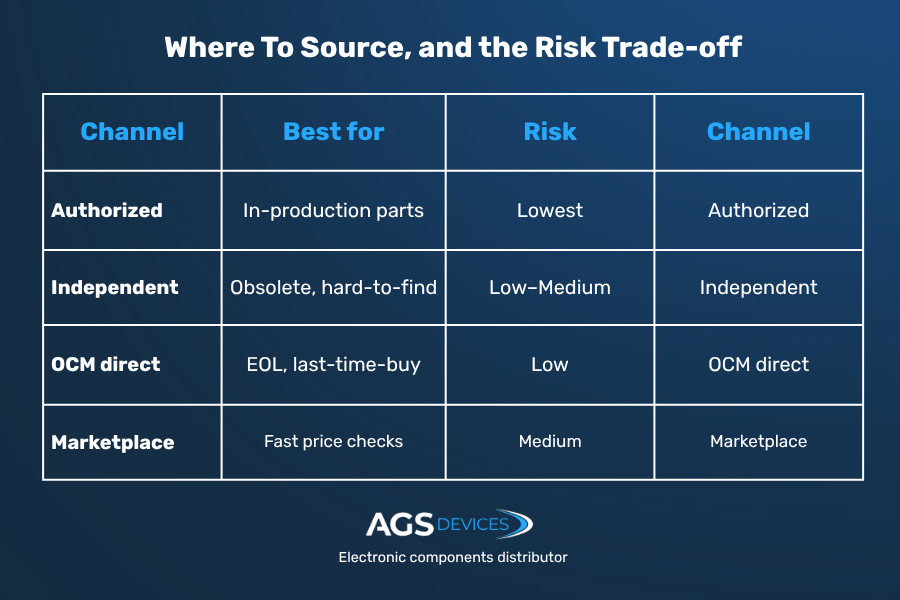
There’s no single best channel, only the right channel for your situation. Here’s how the main options stack up.
1. Authorized Distributors
Authorized distributors should always be your first call. They source directly from the manufacturer, so you get full traceability, manufacturer warranties and the lowest counterfeit risk. The catch: They only carry parts that are still in production, so once a part is obsolete, this channel runs dry.
2. Independent and Specialized Distributors
This is where independent distributors fill a real gap. They maintain relationships with surplus holders, regional markets and other distributors worldwide, so they can often locate stock that doesn’t appear in any authorized channel.
The key question isn’t “authorized or independent?” but “does this supplier have a credible, documented inspection process?” A well-run independent distributor with real testing beats an unknown broker offering cheap stock.
Two things to look for:
- AS6081, the open-market counterpart to AS6496, which sets the counterfeit-avoidance bar for independent distribution
- Active counterfeit screening, where the supplier checks every vendor against databases like ERAI and GIDEP before adding them to an approved vendor list
3. OCM Direct and Last-Time-Buy
For discontinued or long-lead parts, going straight to the original component manufacturer (OCM) can surface options you won’t see elsewhere:
- Production visibility: they may share upcoming schedules so you can time your order
- A recommended replacement: often the cleanest path, straight from the source
- A last-time-buy (LTB): your final chance to secure the part before it’s gone
- Priority allocation: strong relationships can move you up the queue during a crunch
Treat an LTB like a forecasting exercise: Size it to cover remaining production plus service demand, because once that window closes the part moves to the open market at open-market prices. It’s also worth asking about vendor-managed inventory, a model that’s grown fast as buyers try to lock in supply ahead of the next shortage.
4. Marketplaces and Aggregators
Aggregators pull stock and pricing from hundreds of sources into one view, which makes them great for fast availability checks and price comparison.
Their rise tracks a broader shift to digital procurement: Online component sales grew roughly 28% in 2023.
What you should have in mind is to treat the listings as leads, not gospel. They often include outdated stock or unknown vendors, so anything you find here still needs validation before you buy.
5. Excess Inventory and Brokers
Brokers and excess-inventory channels can locate rare parts fast, but they carry the highest counterfeit and quality risk.
Use them only with full verification, and lean hard on suppliers who reference recognized anti-counterfeit standards. If a price looks too good during a shortage, that’s a warning sign, not a win.
How To Vet a Supplier for Hard-to-Find Parts
The supplier matters as much as the part. Before you place an order outside authorized distribution, run this checklist:
- Documented inspection process: they can describe exactly how they verify incoming parts.
- Traceability: a chain of custody back to the manufacturer or an authorized channel, with certificates of conformance.
- Standards alignment: they reference SAE AS6081 (counterfeit avoidance), AS9120 or ISO 9001 quality systems.
- Right-to-reject: clear terms that let you return verified nonconforming parts.
- Reputation signals: participation in industry reporting like the ERAI database, and a track record you can check.
Pro tip: Ask a prospective supplier to walk you through their last counterfeit catch. A credible partner will have a real story and a documented process. A weak one will get vague fast.
Avoiding Counterfeits When Sourcing Off Authorized Channels
The moment you step outside authorized distribution, your counterfeit exposure jumps, and the data is moving the wrong way.
Counterfeit and nonconforming part reports hit a nine-year high in 2024, with 1,055 suspect parts logged, a 25% jump over 2023. Obsolete parts were the single biggest slice at nearly 43%, which is exactly the category you’re sourcing when a part is hard to find.
Verification works in layers, cheapest and fastest first:
- Documentation review: Cross-check part, lot and date codes across the certificate of conformance, labels and packaging.
- Visual inspection: Look for resurfacing, mismatched date codes, blurry markings or bent leads.
- X-ray: Compare internal structure and wire bonds against a known-good sample, without destroying the part.
- Electrical and functional testing: Prove the part performs to spec before it goes into production.
One encouraging data point: Third-party test labs and independent distributors together account for the large majority of counterfeit detection, while manufacturers report under 6%, ERAI says.
In other words, a good independent distributor is part of your defense, not just a risk. Long-stored stock also needs proper handling per JEDEC J-STD-033, and the parts that fail our incoming inspection most often are the rushed buys from an unvetted broker during an allocation crunch.
Proactive Strategies So You’re Not Always Firefighting
The best sourcing teams don’t wait for a shortage. A little preparation turns a crisis into a non-event.
1. Design for Availability and Multisourcing
Availability is a design decision long before it’s a procurement one. Where you can, specify parts with stable supply and more than one qualified source.
- Choose components with healthy lifecycle status during design (design for availability).
- Qualify a second source for critical parts so one discontinuation doesn’t stop the line.
- Diversify suppliers across regions to blunt local disruptions.
2. BOM Monitoring and EOL Watchlists
You can’t react to a risk you can’t see. Tie lifecycle monitoring to your live BOM so engineering and procurement get the same early warning at the same time. Remember that a meaningful share of lifecycle changes arrive with no formal Product Change Notice, so passive waiting isn’t a strategy.
3. Buffer Stock and Last-Time-Buy
When a shortage’s root cause is structural, secure supply ahead of the gap. Calculate lifetime demand for the remaining production run, add a buffer for yield and service, and place a last-time-buy before the deadline. Plan storage conditions up front, since LTB stock may sit for years before you use it.
When To Pivot to an Alternative Part
Sometimes the part is simply gone, and no channel will conjure it. That’s the moment to qualify a replacement instead of chasing ghosts.
If you’re weighing drop-in, cross-reference, form-fit-function or functional options, our guide to choosing alternative electronic parts walks through how to validate each one.
The principle is simple: once sourcing the exact part stops being realistic, a properly qualified alternate keeps you moving without betting the build on a risky buy.
Why Buyers Choose AGS Devices for Hard-to-Find Electronic Components
AGS Devices is an independent distributor built for exactly this challenge: locating and verifying hard-to-find parts when authorized channels come up empty.
Here’s what the team brings:
- Component sourcing across a vetted network of independent and authorized suppliers, plus excess-inventory channels for obsolete and allocated parts
- Shortage and obsolescence solutions that secure critical components during allocations and lifecycle transitions
- BOM management that cross-references your list, flags EOL and NRND risk, and quotes verified availability fast
- In-house inspection and testing on every lot, with traceability, test reports and certificates of conformance on request
Sourcing Hard-to-Find Electronic Components: FAQs
Here are the questions buyers and engineers ask us most often about sourcing hard to find parts.
What makes an electronic component hard to find?
A component becomes hard to find when it’s discontinued (EOL), stuck in allocation, single-sourced, or hit by a sudden demand spike. Each cause behaves differently: an EOL part is gone for good, while an allocated part still exists but carries a long lead time.
Where do I start when a part is unavailable?
Start by confirming that the shortage is real. Check authorized distributor stock and restock dates, then verify lifecycle status on the manufacturer’s page. If the part shows zero stock everywhere with no restock date, move to specialized and independent distributors.
What’s the difference between authorized and independent distributors?
Authorized distributors source directly from the manufacturer, offering full traceability and the lowest counterfeit risk, but they only stock active parts. Independent distributors access surplus, excess and global networks to find obsolete and rare parts that authorized channels no longer carry.
How do I avoid counterfeit parts when sourcing hard-to-find components?
Demand traceability and certificates of conformance, and buy from suppliers that reference anti-counterfeit standards like SAE AS6081. Insist on inspection and testing, including visual, X-ray and electrical checks where the risk warrants.
Are independent distributors safe to use?
Yes, when they’re properly vetted. The deciding factor isn’t the label “independent,” it’s whether the supplier has a documented inspection and verification process. A well-run independent distributor with real testing and traceability is often safer than an unknown broker, and independent distributors catch a large share of counterfeits industry-wide.
What is a last-time-buy (LTB)?
A last-time-buy is your final chance to purchase a part before the manufacturer stops production. It’s triggered by an EOL or discontinuation notice with a stated deadline. To size an LTB, estimate remaining production and service demand, add a buffer, and arrange proper long-term storage, since the stock may sit for years.
How much buffer stock should I hold for at-risk parts?
For an ongoing shortage, buffer stock of about 10 to 30% above immediate need is a reasonable hedge. The right number depends on supplier reliability, lead-time variability and how critical the part is. Avoid over-hoarding, since excess stock ties up capital and can worsen the shortage for other buyers.
How long do component shortages usually last?
It depends on the cause. Demand-spike shortages often ease within 3 to 6 months as supply catches up, while EOL discontinuations are permanent and require an alternate or a last-time-buy. Allocation shortages tied to structural capacity limits, like the current power-semiconductor crunch, can persist far longer.
Can I negotiate pricing on hard-to-find parts?
Often, yes, especially on larger volumes or long-term commitments. Strong supplier relationships, tiered quotes across volume levels and flexible timing all help. During acute shortages your leverage drops, which is another reason a modest buffer and proactive sourcing usually beat reactive spot buys at peak prices.
When should I source an alternative instead of the exact part?
Source an alternative when the original is permanently obsolete, when every channel shows no stock, or when lead times blow past your production window. A qualified replacement (drop-in, cross-reference, form-fit-function or functional) keeps you moving.