
Aerospace Materials & Sourcing: Key Takeaways
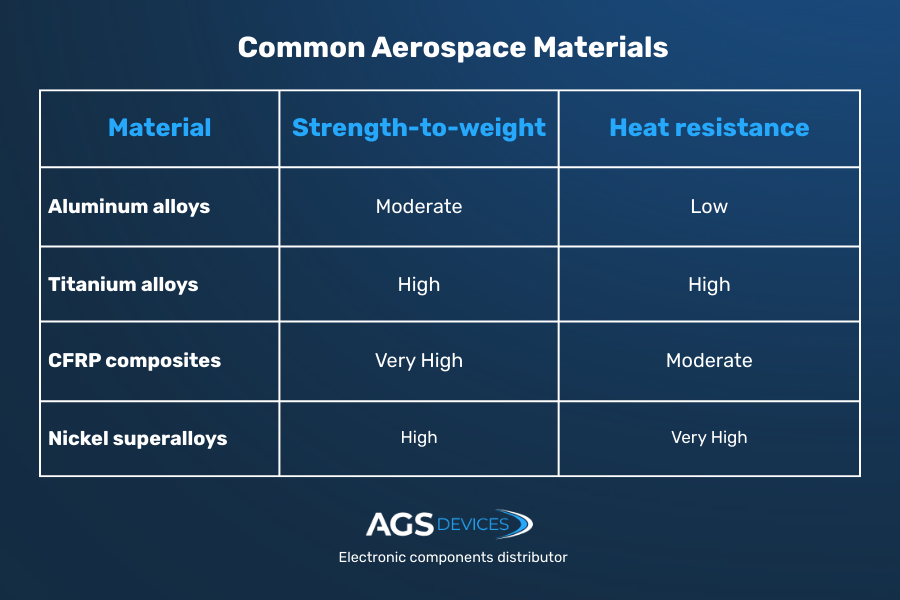
- Titanium is widely used in jet engines and landing gear because it maintains strength at high temperatures while resisting corrosion and fatigue
- Aluminum remains a primary airframe material due to its machinability, low density, and cost efficiency, particularly in fuselage skins and wing structures
- Carbon fiber composites have significantly changed aircraft design by reducing structural weight while maintaining rigidity
- Some aerospace materials do niche work with high stakes: think silicon carbide in electronics or beryllium in satellite optics
- In manufacturing, aerospace materials must meet strict regulatory and certification requirements before approval for flight use
The average commercial jet contains between 4 and 6 million parts, and not even one is allowed to fail.
Every bolt, alloy, and composite layer is there for a reason, and every material must perform under extreme heat, vibration, pressure, and fatigue, often for decades at a time.
That’s why aerospace materials aren’t chosen lightly. The wrong metal can add unnecessary weight and the wrong composite can shorten service life.
From titanium and aluminum to advanced composites and specialty alloys, material selection sits at the intersection of performance, safety, and compliance.
In this guide, we’ll explore:
- The most common aerospace metals, composites, and specialty materials
- How each material is used in flight‑critical avionics systems
- Which certifications and specifications really matter
Aerospace Materials: Key Functions in Flight
Aerospace materials are engineered to perform in extreme operating environments.
From the burning heat of atmospheric reentry to the sub-zero chill at cruising altitude, they must deliver peak performance without compromise.
What defines a material as aerospace-grade? It comes down to a tightly controlled set of performance criteria:
- High strength-to-weight ratio: Less weight = more efficiency, range, and payload capacity
- Exceptional fatigue resistance: Withstands millions of stress cycles over years of service
- Thermal and chemical stability: Performs under wide temperature swings and exposure to fuels or lubricants
- Corrosion resistance: Essential for longevity, especially in marine, humid, or high-altitude environments
- Certification traceability: Every material must meet standards like AMS, MIL, ISO, or NADCAP, and be traceable back to its origin
In aerospace, it’s not just about material science, it’s about mission readiness. Whether it’s a bolt in a wing spar or the skin of a reentry vehicle, the materials must prove themselves under pressure, vibration, heat, and time.
Common Metals Used in Aerospace Manufacturing
From engines that burn hotter than volcanoes to airframes that defy gravity at 35,000 feet, the metals used in aerospace must perform in conditions few materials ever encounter.
The goal of these common metals is to reduce mass wherever possible without compromising structural integrity or fatigue life.
Titanium Alloys
Titanium alloys are widely used in aerospace due to their high strength-to-weight ratio and resistance to corrosion, particularly in high-temperature and high-stress environments.
They perform reliably in components exposed to cyclic loading and thermal variation, which is why they are commonly found in jet engine assemblies, landing gear structures, and primary airframe components.
Although more expensive and challenging to machine than aluminum, their long-term durability often justifies the cost in critical applications.
Most commonly used in: Jet engine avionics components, landing gear, structural frames
Fun fact: In high-performance military aircraft, titanium can account for up to 10% of the structural weight.
Aluminum Alloys
The original aerospace hero is still flying high thanks to its versatility and low cost.
- Lightweight and easily formed
- Good fatigue strength
- Lower melting point than titanium or steel
Used in: Fuselage skins, wing structures, bulkheads
Common series: 2024 (high strength), 6061 (versatile), 7075 (ultra-strong)
Stainless & High-Temp Steels
When heat, vibration, and wear come into play, stainless steps in to hold the line.
- Exceptional wear and fatigue resistance
- Handles moderate temperatures
- Easily fabricated and sourced
Used in: Exhaust manifolds, fasteners, hydraulic tubing
Popular grades: 17-4PH (precipitation-hardened), A286 (high-temp alloyed steel)
Nickel-Based Superalloys (e.g., Inconel®)
Nickel-based superalloys are specifically developed to retain mechanical strength and oxidation resistance at temperatures exceeding 1,000°C.
- They are also resistant to thermal creep and oxidation
- Although difficult to machine, their performance in turbines and exhaust systems justifies the added manufacturing complexity.
Used in: Turbine blades, afterburners, exhaust nozzles
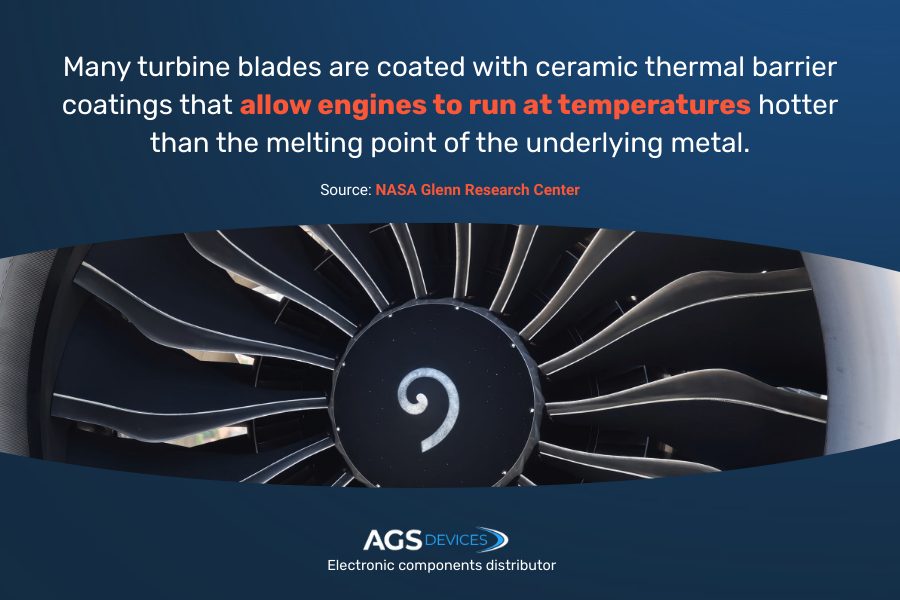
Did you know? Modern aircraft engines use single-crystal nickel-based superalloy turbine blades to eliminate grain boundaries.
Composite Materials in Aerospace Applications
If metals are the skeleton of an aircraft, composites are its muscles: strong, flexible, and built to perform under pressure. From stealth drones to space-grade propulsion, composite materials are redefining what’s possible at altitude.
CFRP (Carbon Fiber Reinforced Polymer)
The aerospace all-star that’s changing what aircraft are made of.
- Exceptional strength-to-weight ratio
- Corrosion- and fatigue-resistant
- Reduces overall fuel burn and maintenance cost
Used in: Wings, fan blades, control surfaces, fairings, UAV frames
Example: The Boeing 787 Dreamliner is built with over 50% CFRP by weight, dramatically improving fuel efficiency.
GFRP (Glass Fiber Reinforced Polymer)
The underrated workhorse that delivers strength on a budget.
- More affordable than carbon fiber
- Excellent impact resistance
- Electrically insulating
Used in: Interior panels, nose cones, fairings, and radomes
Fun fact: GFRP is widely used in commercial aviation cabins for its flame resistance and ease of molding.
Aramid Fiber (Kevlar®)
Tough, flexible, and ready for battle, literally.
- Great tensile strength and energy absorption
- Resistant to impact and ballistic threats
- Flexible under mechanical stress
Used in: Ballistic panels, helicopter rotor blade skins, engine nacelles.
Did you know? Aramid fibers such as Kevlar® are used in certain military rotorcraft applications to provide impact resistance while reducing overall weight.
Ceramic Matrix Composites (CMCs)
Ceramic matrix composites are used in applications where traditional alloys cannot maintain structural stability at extreme temperatures.
- Operate beyond 1,300°C, ideal for extreme environments
- High thermal shock resistance
- Retain strength at ultra-high temps
Used in: Turbine nozzles, heat shields, re-entry systems, next-gen jet propulsion
Bonus fact: CMCs are used in NASA spacecraft to protect against re-entry temperatures exceeding 1,500°C.
Specialty Materials for High-Performance Aerospace Parts
When standard metals won’t cut it, engineers turn to specialty materials built for the extremes of aerospace and defense. These materials are selected for their unique thermal, structural, or radiation-resistant properties.
- Silicon carbide (SiC): Used in high-temp electronics and thermal shielding for satellites and propulsion systems
- Tungsten alloys: Ideal for counterweights, kinetic penetrators, and radiation shielding in defense and space
- Magnesium alloys: Extremely lightweight with excellent machinability; used in UAVs, housings, and gearbox structures
- Beryllium: Lightweight, stiff, and dimensionally stable; used in missile systems and space-based optical instruments (with strict handling requirements due to toxicity)
Tungsten’s melting point exceeds 3,400°C, which makes it suitable for rocket nozzles and high-temperature shielding applications.
How AGS Devices Helps You Source Aerospace-Grade Materials
In aerospace, sourcing isn’t just about availability. It’s about trust, traceability, and certification.
Whether you’re supporting next-generation propulsion systems or managing avionics and flight-critical electronics for MRO, AGS Devices delivers more than just parts. We deliver confidence.
We also support your full component sourcing needs, offering:
Need certified avionics hardware or hard-to-source aerospace electronics? Our team works with vetted global suppliers to reduce lead times and ensure full compliance documentation.
Aerospace Materials: FAQs
Because aerospace materials operate under extreme conditions, it’s natural to have questions about how they’re selected, tested, and sourced.
What are the most used aerospace materials?
Titanium alloys, aluminum alloys, high-temperature steels, carbon fiber composites, and nickel-based superalloys are widely used due to their strength, low weight, and resistance to extreme conditions.
Why is titanium used in aerospace components?
Titanium offers an excellent strength-to-weight ratio and high corrosion resistance. It can withstand high temperatures, making it ideal for airframes, engine parts, and landing gear.
What is the role of composite materials in aircraft?
Composites like carbon fiber reduce overall aircraft weight while maintaining strength and rigidity, improving fuel efficiency and performance.
How do aerospace materials differ from standard industrial materials?
Aerospace-grade materials must meet stricter certifications, have higher fatigue resistance, and perform reliably in extreme temperature, pressure, and stress conditions.
What certifications are required for aerospace materials?
Materials typically require certifications such as AS9100, MIL-SPEC, or compliance with aerospace OEM specifications for airworthiness and traceability.
Where are high-temperature materials like Inconel used in aerospace?
Nickel-based superalloys like Inconel are used in turbines, heat shields, and afterburners due to their ability to maintain strength above 1,000°C.
How can I source certified aerospace materials?
Work with qualified sourcing partners that provide full traceability, compliance documentation, and supplier verification. In aerospace programs, documentation gaps are one of the most common causes of part rejection. Even when performance requirements are met, incomplete traceability can delay approval and integration.
Can AGS Devices help with sourcing hard-to-find aerospace components?
Yes. AGS Devices supports aerospace and defense programs with shortage management, BOM optimization, and sourcing solutions for certified avionics hardware and flight-critical electronic components.