
Integrated Avionics Systems: Key Takeaways
- Integrated avionics replace isolated boxes with shared intelligence, reducing complexity while increasing capability
- IMA architectures can cut avionics wiring by 30% or more, lowering weight and improving fuel efficiency
- Centralized processing enables faster diagnostics, simpler upgrades, and fewer maintenance touchpoints
- Deterministic buses and software partitioning make fault tolerance a design rule, not a fallback
- Integrated avionics are the backbone of aircraft autonomy, AI-assisted flight, and next-generation UAVs
- AGS Devices supports integration with certified, traceable avionics components built for aerospace reality
A single commercial jetliner may carry over hundreds avionics subsystems, each responsible for a critical function such as navigation, communication, engine control, flight display, or diagnostics.
Alone, they’re impressive. But when orchestrated through an integrated avionics system, they operate like a finely tuned digital brain, processing thousands of signals per second with near-zero tolerance for error.
The architecture behind today’s flight decks looks very different from the federated systems used just a few decades ago.
Integrated avionics consolidate multiple systems into a shared, modular infrastructure, boosting performance, reducing weight, and enabling real-time decision-making that can quite literally mean the difference between safety and catastrophe.
In this guide, we’ll unpack the power behind today’s integrated avionics systems:
- How they’re structured and why they’ve replaced older federated setups
- The key modules, displays, and processors working behind the scenes
- What real-world benefits they offer for pilots, maintenance crews, and OEMs
- The hidden challenges behind flawless system integration
Integrated Avionics Systems: Key Functions & Overview
Integrated avionics emerged from a simple engineering problem: isolated subsystems created unnecessary complexity. Each box required its own processing, wiring, cooling, and maintenance path. Over time, that model became difficult to scale.
The solution? Integrated avionics, a shift from isolated subsystems to a centralized, modular architecture where everything is connected, aware, and optimized for performance and safety.
Core functions these systems manage:
- Flight control & automation: Autopilot, flight directors, and stability augmentation systems work through shared processing cores
- Navigation & communication: GPS, SATCOM, VHF/UHF radios, and data links are routed through integrated processors for synchronized outputs
- Monitoring & diagnostics: Engine performance, system health, and fault alerts are monitored in real time, enabling predictive maintenance and faster response
- Sensor-to-actuator data flow: Information from inertial sensors, altimeters, or radar is relayed to flight computers and pilot displays through unified buses
The F-22 Raptor is often cited as one of the first platforms to fully leverage sensor fusion across integrated avionics, allowing radar, electronic warfare, and targeting systems to share data in near real time.
Core Architecture of Integrated Avionics
At 35,000 feet, reliability isn’t optional, it’s engineered. That’s why modern aircraft rely on Integrated Modular Avionics (IMA) architecture: a scalable, modular system design that replaces bulky, isolated boxes with shared computing environments.
The shift toward IMA parallels broader computing trends. Instead of dedicating hardware to a single function, avionics designers hosting multiple certified applications on shared processing modules, while keeping them logically isolated.
Integrated Modular Avionics: The Foundation
This is where modern avionics quietly changed the rules, replacing racks of isolated boxes with shared intelligence that’s smarter, lighter, and easier to scale.
- Consolidates multiple avionics functions (nav, comms, FMS) into shared computing modules
- Reduces hardware duplication and wiring complexity
- Each module runs partitioned software, ensuring faults don’t cascade across systems
Fun fact: Airbus was one of the first commercial manufacturers to adopt IMA in the A380, improving scalability and reducing maintenance costs across its fleet.
Deterministic Communication & Data Buses
In avionics, “fast” isn’t enough. Data has to arrive on time, every time, and these communication standards are what keep the entire system in sync at altitude.
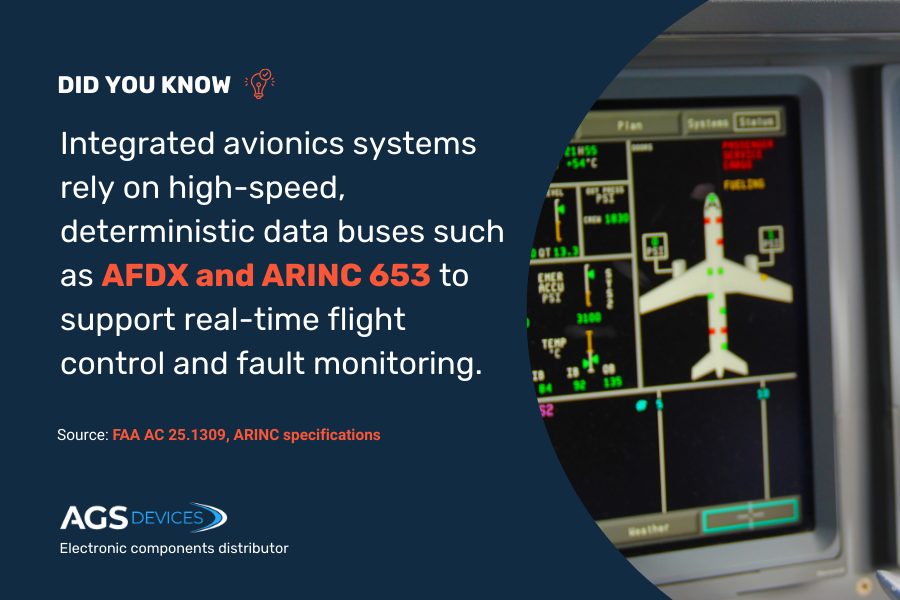
- Communication uses protocols like ARINC 653, AFDX (Avionics Full-Duplex Ethernet), and MIL-STD-1553
- This enables predictable timing and real-time message delivery between subsystems
- It’s vital for autopilot, flight control, and safety systems where milliseconds matter
Example: On the Boeing 787, AFDX links over 150 systems with guaranteed bandwidth and redundancy.
Safety Through Software Partitioning
Here’s the invisible safety net most passengers never think about: software isolation that ensures one failure never turns into a system-wide problem.
- Critical and non-critical tasks run in separate, sandboxed environments on the same hardware
- This prevents interference between systems like entertainment (IFE) and flight control
- And it supports regulatory compliance with DO-178C and RTCA standards
Analogy: It’s like running your banking app and a video game on the same phone, with a firewall in between. If the game crashes, your finances stay safe.
Key Components in Integrated Avionics Systems
Behind every seamless flight lies a network of precision-engineered components, quietly managing, computing, and communicating in real time.
Here’s a closer look at the components that make it all work:
- Core processing modules (CPMs): These are the computational brains of the operation, hosting multiple software applications on a single module through partitioned environments. They reduce hardware weight while improving redundancy and data processing capabilities.
- Remote data concentrators (RDCs): Acting like data hubs, RDCs collect signals from dozens of sensors and transmit them over high-speed buses to central modules. Their distributed placement dramatically cuts down on cabling and latency.
- Avionics switches and routers: These manage real-time data routing across the system. Using deterministic protocols like AFDX, they ensure priority messages (e.g., autopilot corrections) arrive exactly when needed, no buffering, no delay.
- Flight management systems (FMS): Think of this as a digital co-pilot. The FMS automates route planning, navigation, fuel optimization, and engine performance, all while continuously integrating inputs from multiple subsystems.
- Displays and control panels (Glass Cockpits): The visible tip of the iceberg. Touchscreen interfaces, Primary Flight Displays (PFDs), and Heads-Up Displays (HUDs) translate complex data into fast, readable, intuitive visual cues for pilots.
Did you know? The Boeing 787 Dreamliner uses over 60 remote data concentrators, not just to cut 20 miles of wiring, but to increase speed, reduce weight, and improve diagnostic clarity across the aircraft.
Benefits of Integrated Avionics for Modern Aircraft
Why is the aviation world trading bulky, federated systems for sleek, integrated ones? Because in the air, every pound counts, every second matters, and every signal must be trusted.
Here’s what integrated avionics deliver:
- Smaller footprint: Reduced size, weight, and power (SWaP) mean lighter aircraft and better fuel efficiency
- Smarter maintenance: Real-time fault detection accelerates troubleshooting and reduces downtime
- Streamlined upgrades: Modular systems allow for faster tech refreshes without redoing the entire architecture
- Built-in safety: Enhanced redundancy and continuous data-sharing boost reliability
- Future-ready: Easily adaptable for autonomy, AI, and advanced mission systems
Fun fact: In many implementations, integrated architectures reduce wiring requirements significantly, which directly impacts weight and fuel burn.
Integrated vs. Federated Avionics Systems
Not all aircraft systems are created equal. The shift from federated to integrated avionics marks a leap forward in how we fly, maintain, and upgrade aircraft.
Knowing the difference helps identify which platforms are legacy and which are future-ready.
System architecture comparison:
| Feature | Federated Avionics | Integrated Avionics (IMA) |
| Architecture | Independent systems per function | Modular, centralized framework |
| Maintenance | Complex with more wiring and LRUs | Simplified diagnostics and fewer parts |
| Upgrade Flexibility | Rigid and siloed | Scalable and easily reconfigurable |
| Weight & Power | Heavier and more power-intensive | Optimized SWaP (Size, Weight, Power) |
| Common Use | Legacy aircraft, general aviation | Commercial, defense, UAVs, space systems |
Did you know? Early federated systems required miles of additional wiring per aircraft compared to today’s integrated counterparts, increasing weight and maintenance costs significantly.
How AGS Devices Helps You Build Better Integrated Avionics Systems
Modern aircraft demand more than just cutting-edge avionics. They need systems that are lighter, smarter, and fully integrated from the inside out. But behind every reliable system is a supply chain that delivers on performance, compliance, and precision.
AGS Devices supports aerospace engineers, MROs, and OEMs with sourcing strategies tailored for integrated avionics:
- Fully traceable, certified components for IMA frameworks
- Support for long-lead, hard-to-find, and end-of-life parts
- BOM Management optimization and custom kits that reduce downtime
- Shortage and Obsolescence Solutions aligned with industry roadmaps
For engineering teams, the challenge isn’t just selecting the right architecture. It’s sourcing components that remain available, certifiable, and supportable over the aircraft’s lifecycle. That’s often where integration efforts stall.
We also provide electronic components such as:
AGS Devices works with OEMs and MRO providers to reduce that friction, supporting IMA programs with certified, traceable components and long-term supply strategies.
Integrated Avionics Systems: FAQs
What is an integrated avionics system in aviation?
An integrated avionics system combines multiple flight-critical functions like navigation, communication, and monitoring into a centralized, modular framework for improved performance and efficiency.
How does integrated avionics differ from traditional federated systems?
Federated systems use separate hardware for each function, while integrated systems share processing and data pathways, reducing weight, wiring, and complexity.
What are the main benefits of integrated avionics?
Integrated systems offer reduced SWaP (size, weight, and power), faster diagnostics, easier upgrades, and enhanced redundancy for safety-critical operations.
Where are integrated avionics systems used?
They’re commonly found in modern commercial jets, military aircraft, advanced UAVs, and next-generation space vehicles.
What components are part of integrated avionics systems?
Core processing modules, remote data concentrators, avionics routers, FMS units, and cockpit display systems are key components.
What is IMA (Integrated Modular Avionics)?
IMA is an avionics architecture where multiple software applications share common computing resources in isolated, secure partitions.
Can AGS Devices help with sourcing integrated avionics components?
Yes. AGS Devices provides certified, traceable components for integrated avionics, including support for obsolescence management, BOM optimization, and custom kitting.