
Avionics Systems: Key Takeaways
- It all starts with the components. From flight control computers to inertial sensors, from power supplies to data buses, avionics systems are only as reliable as the parts behind them
- Architecture shapes capability. Whether it’s a legacy federated setup or an IMA-based network, how systems are connected defines how well they respond, adapt, and scale
- Integration is the pressure test. Bringing components together isn’t just technical, it’s strategic. Timing, compatibility, cybersecurity, and certification all come into play
- Digital displays aren’t just for aesthetics. Glass cockpit avionics give pilots clarity, control, and confidence, streamlining complex data into intuitive interfaces
- Tomorrow’s avionics demand openness. Standards like MOSA and FACE aren’t just buzzwords. They’re what make modernization possible across airframes and missions
- AGS Devices supports the full avionics picture. We help aerospace teams source critical electronics, manage BOMs, and stay ahead of obsolescence, with quality that flies
What keeps a 200-ton aircraft flying steady through turbulence at 35,000 feet? It’s not just the engines. It’s the invisible intelligence behind the scenes: the avionics.
Onboard today’s commercial jets, over 100 interconnected avionics systems work in unison to navigate, stabilize, communicate, monitor, and protect.
From autopilot decisions to radar alerts to engine diagnostics, avionics form the digital nervous system of modern aviation.
But behind every alert and interface lies a web of precisely engineered components, and they all need to speak the same electronic language.
In this guide, we’ll explore:
- What avionics systems actually are, and why they matter
- The evolution of avionics architecture from federated to modular
- Key avionics components and integration challenges
- How AGS Devices supports sourcing for critical aerospace electronics
Why Avionics Systems Are the Nerve Center of Modern Aircraft
Avionics systems are no longer limited to basic flight instruments. Today, they’re central to how aircraft operate, respond, and adapt in both manned and unmanned platforms.
Here’s why they matter across aerospace sectors:
- Flight-critical operations: Control navigation, communication, surveillance, and onboard system logic
- Ubiquity across platforms: Used in commercial jets, military aircraft, satellites, rotorcraft, and UAVs
- Enablers of automation: Power autopilot, fly-by-wire systems, and mission-specific software
- Support for real-time decision-making: Deliver sensor data, alerts, diagnostics, and response protocols
Fun fact: The term “avionics” is a blend of aviation and electronics, first coined during WWII when aircraft began integrating radar, communications, and flight controls into centralized systems.
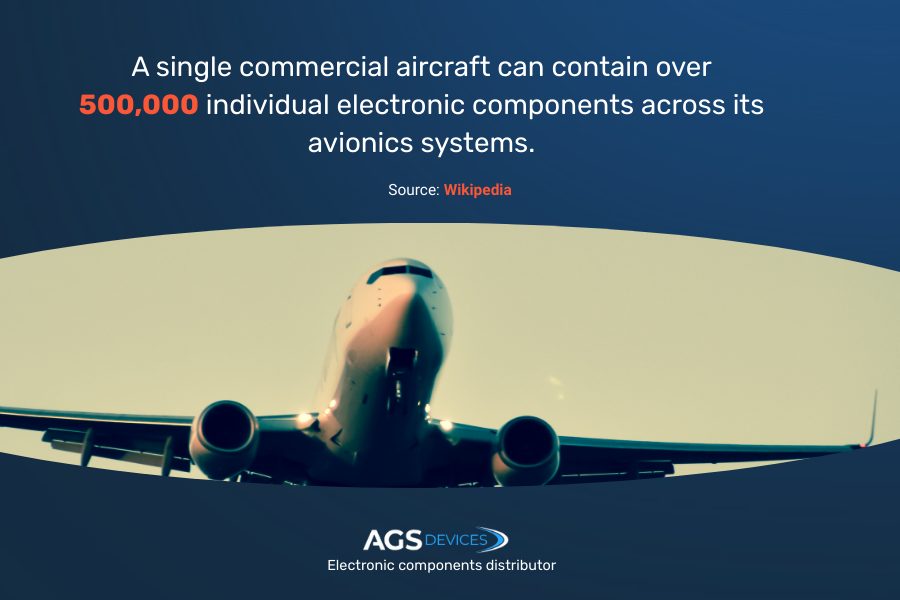
Some flight control computers are built with triple or quadruple redundancy, meaning they run multiple parallel processors constantly cross-checking each other
Avionics Systems Architecture: From Federated to Integrated Systems
From isolated black boxes to fully integrated computing platforms, the shift in architecture directly impacts aircraft performance, maintainability, and upgrade potential.
Back in the early days of aviation, each system lived in its own box. But as cockpits got smarter, that model couldn’t keep up.
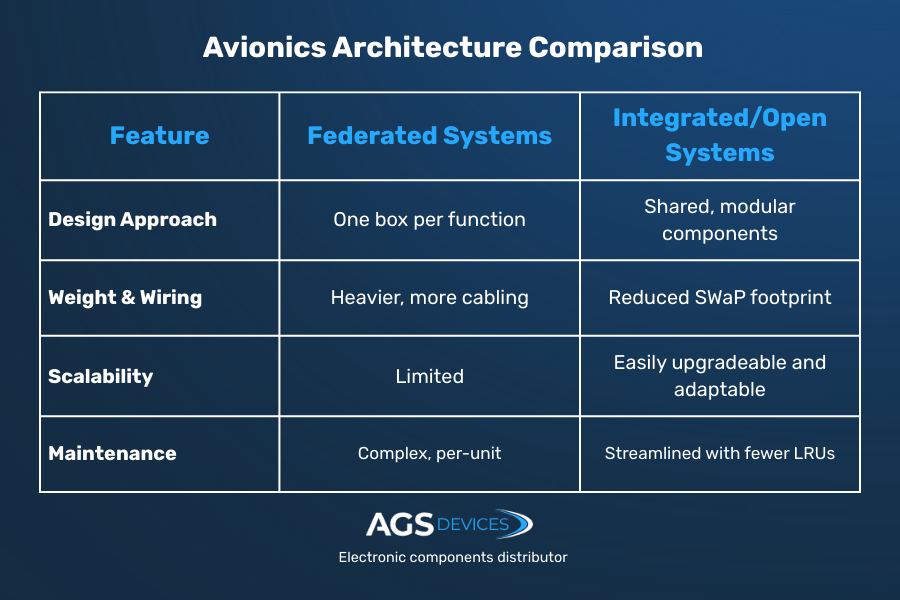
Federated Architecture: The Traditional Model Still in Flight
Think of this as the “one box, one function” approach. Each avionics component handles a specific task, but that separation comes at a cost.
- Independent systems for navigation, communication, flight control, etc.
- High levels of redundancy, but with increased wiring weight and space usage
- Common in legacy aircraft, general aviation, and retrofit programs
- Limited scalability and integration with modern digital systems
️Example: Many C-130 and early-generation business jets still operate on federated avionics.
Integrated Modular Avionics (IMA): Smarter, Lighter, Centralized
IMA revolutionized avionics design by consolidating multiple functions into shared computing platforms, increasing efficiency while reducing complexity.
- Modular line-replaceable units (LRUs) with multiple applications per unit
- Significant reductions in SWaP (size, weight, and power)
- Shared data buses (e.g., ARINC 429, AFDX) and fault-tolerant processors
- Commonly deployed in advanced aircraft like the Boeing 787 and Airbus A350
The main benefits are: easier maintenance, faster software updates, and fewer physical boxes on board.
Open Architecture: Future-Ready, Flexible, and Mission-Critical
Modern aerospace demands agility. Open architecture systems are built to adapt, across missions, platforms, and vendors.
- Designed around standards like FACE (Future Airborne Capability Environment), MOSA, and ARINC 653
- Promotes vendor interoperability, reuse, and long-term scalability
- Ideal for UAVs, optionally piloted vehicles, and next-gen military platforms
- Supports secure integration of third-party modules and AI-based systems
Example: U.S. Department of Defense mandates MOSA compliance for major air platforms.
Integration Challenges in Modern Avionics
Bringing together multiple avionics components into one cohesive system is no small task. As aircraft become more autonomous and software-driven, integration is now one of the most critical and complex phases in system development.
Here are the biggest integration hurdles today’s aerospace teams face:
- Vendor interoperability: Aligning systems from multiple manufacturers with different communication protocols and design standards
- Real-time processing: Ensuring data is received, computed, and acted on with minimal latency, essential for flight control and safety systems
- Cybersecurity: Protecting mission-critical data streams from unauthorized access or signal interference, especially in networked and unmanned platforms
- Environmental reliability: Designing for EMI/EMC resilience, thermal extremes, altitude, and vibration in harsh aerospace environments
- Certification complexity: Meeting standards like DO-178C (software), DO-254 (hardware), and ARP4754A (system development) across all components and integrations
- Scalability & modularity: Designing systems that can grow or adapt to future needs using MOSA and open architecture principles
The recent semiconductor shortage highlighted just how vulnerable avionics supply chains can be, with lead times ballooning across aerospace-grade components.
Core Components of Avionics Systems
Every avionics system is built on a mix of sensors, processors, displays, and interfaces, each playing a vital role in how aircraft operate, communicate, and stay safe.
Here’s what powers them:
Flight Control & Navigation
Modern aircraft rely on precision navigation and flight control systems to maintain course, altitude, and stability in all conditions.
- Inertial Navigation Systems (INS) and GPS for continuous positioning
- Air Data Computers to measure airspeed, altitude, and angle of attack
- Flight Management Systems (FMS) for route planning and optimization
- Attitude and Heading Reference Systems (AHRS) for orientation data
Many avionics-grade chips rely on semiconductor doping techniques to fine-tune electrical performance and withstand harsh aerospace environments.
Did you know? Some high-performance AHRS units update aircraft attitude data more than 100 times per second, ensuring real-time accuracy in turbulent conditions.
Communication & Surveillance
Clear, continuous communication and situational awareness are essential for both civil and military aircraft.
- VHF/UHF radios handle routine voice comms; SATCOM kicks in over oceans or remote zones
- SATCOM links provide secure, high-altitude communication when line-of-sight fails
- ADS-B constantly shares real-time position, way more accurate than radar
- TCAS and Mode S transponders warn pilots about nearby aircraft automatically
- Weather radar scans for storms, turbulence, and lightning to help steer clear
Did you know? ADS-B is now mandatory in controlled U.S. airspace and improves position accuracy compared to traditional radar.
Displays & Human-Machine Interfaces (HMI)
Today’s cockpits are smarter, cleaner, and more digital, thanks to evolving avionics display systems.
- Glass cockpit avionics with integrated flight displays
- Multifunction Displays (MFDs) and Heads-Up Displays (HUDs)
- Control panels, keyboards, and touchscreen interfaces
Fun fact: The Boeing 787 Dreamliner cockpit uses multiple digital displays (including a HUD) driven by advanced avionics systems that reduce cockpit clutter and help pilot decision-making.
Power, I/O & Processing Hardware
Avionics hardware must be rugged, reliable, and ready for complex, real-time processing across multiple systems.
- Avionics power supplies (e.g., 28V DC, 115V AC) for clean, stable input
- Data buses like ARINC 429, MIL-STD-1553, and CAN for communication between systems
- Flight Control Computers (FCCs) and modular Line Replaceable Units (LRUs)
- Processing cores that manage inputs from navigation, comms, and sensors
Avionics hardware performance often hinges on the semiconductors inside, from power-efficient processors to ruggedized memory chips. What are semiconductors? Here’s a breakdown of how these critical components function.
Fun fact: Some modern avionics processors perform over 1 billion instructions per second and are expected to do so with zero fault tolerance.
How AGS Devices Supports Advanced Avionics Systems
From legacy platforms to next-gen modular systems, avionics integration requires more than just high-performance electronics. It demands precision sourcing, lifecycle visibility, and supplier reliability.
At AGS Devices, we specialize in helping aerospace manufacturers, integrators, and procurement teams source the avionics components that keep aircraft flying safely and efficiently.
Partner with AGS Devices for:
- Certified avionics components and electronics
- Obsolescence and shortage solutions for critical hardware
- BOM optimization and cross-reference support
- Global sourcing with full traceability and inspection
- Experience across commercial, defense, UAV, and space platforms
We also support your full component sourcing needs, offering:
Avionics Systems: FAQs
Still have questions? You’re not alone. Whether you’re sourcing parts, mapping out an upgrade, or just trying to understand how avionics systems actually work behind the scenes, we’ve got you covered.
What is included in an avionics system?
Avionics systems typically include flight control computers, navigation sensors, communication radios, displays, power supplies, and data buses, all working together to manage aircraft operations.
What are the main components of avionics hardware?
Core avionics hardware includes LRUs, GPS units, FMS computers, VHF/UHF radios, HUDs, MFDs, and power systems designed for EMI/EMC compliance and airborne reliability.
What is the difference between avionics and electronics?
Electronics is the broad field of circuits and components, while avionics refers specifically to the electronic systems used in aircraft for navigation, communication, surveillance, and control.
What is avionics architecture?
Avionics architecture defines how systems are organized and connected, from traditional federated layouts to integrated modular avionics (IMA) and open standards like FACE and MOSA.
What are glass cockpit avionics?
Glass cockpit avionics replace analog gauges with digital displays, providing pilots with real-time data through MFDs, PFDs, and touch interfaces for improved situational awareness.
How does AGS Devices help with avionics sourcing?
AGS Devices provides traceable, certified avionics components, supports lifecycle and obsolescence planning, and delivers high-reliability parts for both legacy and next-gen platforms.
How are semiconductors used in avionics hardware?
Semiconductors are at the heart of avionics systems, powering processors, memory, and communication modules. Whether it’s n-type or p-type semiconductors, each plays a role in how signals are processed and transmitted in-flight. Equally important is semiconductor packaging, which ensures that these components remain lightweight, heat-resistant, and shielded from electromagnetic interference in harsh aerospace environments. What are semiconductors?