
Aircraft Circuit Breakers: Key Takeaways
- In aviation, circuit protection is rarely about convenience, it’s about containment. A breaker isn’t just stopping current; it’s preventing a localized fault from escalating into a system-level event
- Aviation circuit breakers must withstand extreme altitude, vibration, and temperature conditions while meeting strict FAA, DO-160, and MIL-SPEC requirements
- Different aircraft systems require different protection types, from thermal and magnetic breakers in legacy fleets to solid-state power controllers in modern fly-by-wire platforms
- Selecting the correct breaker involves more than matching amperage. Engineers must also account for wire gauge, allowable temperature rise, altitude derating curves, and coordination with upstream and downstream protection devices
- Reliable sourcing is critical. Certified, traceable aircraft circuit breakers from approved suppliers like AGS Devices help prevent compliance issues, downtime, and costly installation errors
Modern commercial aircraft don’t just “have electricity.” They manage it across vast networks of systems, redundancies, and safety layers.
To put scale into perspective, Airbus has publicly stated that the A380 contains roughly 300 miles of wiring supporting avionics, flight controls, cabin systems, and redundancy layers.
Each segment of that network requires layered protection. At the component level, that responsibility often falls to a deceptively small device: the circuit breaker.
And sourcing the right breaker isn’t just about matching amperage. It’s about certification, trip curves, environmental ratings, traceability, and long-term reliability.
In this guide, we’ll cover:
- How aircraft circuit breakers work
- The types used in modern and legacy aircraft
- Where they’re installed and why placement matters
- Certification and compliance requirements
Aircraft Circuit Breakers: Key Functions in Aviation Systems
Aircraft circuit breakers are engineered to isolate faults instantly, preventing a localized issue from cascading into a system-wide failure.
At their core, aircraft circuit breakers:
- Protect electrical systems from overloads and short circuits, interrupting excessive current before wires, connectors, or aerospace components are damaged
- Prevent wire overheating and fire hazards, a critical concern in tightly routed EWIS environments where hundreds of miles of wiring coexist within confined structures
- Isolate faulty subsystems without disabling entire power buses, ensuring essential systems remain operational
- Support zonal electrical architecture, allowing faults to be contained within defined aircraft zones rather than propagating across systems
In transport-category aircraft, circuit protection is embedded within the framework defined under ATA Chapter 24 (Electrical Power). Breakers are not standalone components; they are part of a coordinated load management strategy designed to preserve essential power distribution during abnormal conditions.
You’ll find aircraft circuit breakers integrated into:
- Cockpit breaker panels, providing pilots with manual reset capability and visual fault indication
- Remote power distribution units, especially in modern aircraft with centralized electrical management systems
- Safety-critical load management systems, where fault detection and isolation must occur within milliseconds
How Aircraft Circuit Breakers Work
Aircraft circuit breakers are engineered to trip predictably at altitude, under vibration, and across wide temperature ranges.
Below are the primary mechanisms used in aircraft circuit protection.
1. Thermal Circuit Breakers
Thermal circuit breakers rely on a bimetallic strip that bends when heated by excessive current. When current exceeds the rated value for a defined period, the strip deflects and opens the circuit.
Design attributes include:
- Respond to sustained overload conditions rather than instantaneous faults
- Common in legacy aircraft and general aviation platforms
- Simple internal design with high mechanical reliability
- Slower response compared to magnetic breakers
Real-world example: Older narrow-body aircraft and many business jets use thermal push-pull breakers in cockpit panels to protect lighting circuits, cabin power outlets, and non-essential systems.
2. Magnetic Circuit Breakers
Magnetic circuit breakers use an electromagnetic coil. When current spikes rapidly, such as during a short circuit, the magnetic field instantly pulls a trip mechanism open.
Key characteristics:
- Fast response to short circuit
- Better suited for critical systems requiring rapid fault isolation
- More consistent performance across temperature variations
In transport-category aircraft, magnetic protection is frequently specified for essential bus circuits because rapid isolation minimizes cascade risk.
3. Push-Pull Trip-Free Circuit Breakers
Push-pull breakers are manually resettable units commonly installed in cockpit panels. They are designed as trip-free devices, meaning they cannot be forced closed while a fault condition exists.
In practice, this means:
- Provide visual indication when tripped
- Allow manual reset after fault correction
- Designed to prevent pilot override during an active fault
- Commonly panel-mounted
Did you know: In many Airbus and Boeing cockpit breaker panels, push-pull units protect individual avionics subsystems. If a circuit trips, the breaker extends outward, clearly indicating a fault.
4. Remote Electronic Circuit Breakers and Solid-State Power Controllers
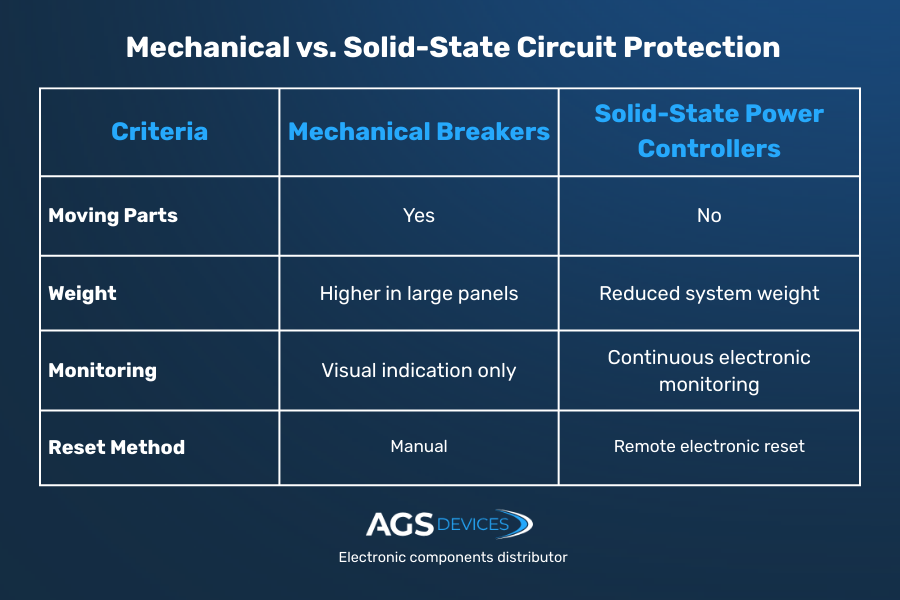
Modern aircraft increasingly use electronic circuit protection, often referred to as Solid-State Power Controllers or SSPCs. These devices replace traditional mechanical breakers with semiconductor-based switching and monitoring.
From a system standpoint:
- No moving mechanical parts
- Trip and reset controlled electronically
- Continuous current monitoring
- Integrated fault reporting
- Weight reduction compared to large mechanical breaker panels
Real-world example: The Boeing 787 and Airbus A350 use remote power distribution systems as part of their Integrated Modular Avionics architecture.
Types of Aircraft Circuit Breakers
Aircraft circuit breakers are selected based on function, installation environment, and the system they are protecting.
Below is a structured breakdown of how aviation circuit breakers are categorized in real-world aircraft systems.
Classification by Function
Different breaker technologies are chosen based on how faults must be detected and isolated.
1. Trip-Free Breakers
Trip-free breakers are designed so they cannot be manually held closed during an active fault. If excessive current exists, the mechanism will open regardless of pilot input.
- Prevents unsafe override during overload conditions
- Common in cockpit panels
- Used in systems where pilot access is required but safety override is not permitted
Example: Cockpit-mounted breakers protecting navigation or communication radios.
2. Manual Reset Breakers
These breakers require physical reset after tripping. They provide clear visual indication of fault occurrence.
- Allow inspection before reactivation
- Common in non-essential or cabin systems
- Often thermal or magnetic in design
Example: Cabin lighting circuits or galley equipment protection.
3. Current Limiters
Unlike traditional resettable breakers, current limiters act more like high-capacity fuses.
- Designed for high-current feeder lines
- Protect main power distribution circuits
- Typically not resettable in flight
Example: Protection between the aircraft battery or generator and the main electrical bus.
4. Solid-State Power Controllers (SSPCs)
SSPCs replace mechanical breakers with semiconductor switching devices.
- Provide fast fault detection
- Allow remote reset and monitoring
- Integrated into digital power management systems
- Reduce wiring weight and panel space
Example: Boeing 787 remote power distribution architecture uses SSPCs within its electrical power system.
Classification by Installation
Circuit breaker selection also depends on where and how it is installed in the aircraft.
- Panel-Mounted Breakers
Installed directly in cockpit or cabin breaker panels.
- Pilot-accessible
- Provide visible trip indication
- Common in legacy and mixed-architecture aircraft
Example: Traditional breaker panels found in Boeing 737 or Airbus A320 cockpits.
- Remote Power Distribution Modules
Installed away from the cockpit, often within avionics bays or equipment racks.
- Controlled electronically
- Often paired with SSPCs
- Reduce cockpit clutter and wiring runs
Example: Power distribution centers in modern fly-by-wire aircraft.
- Rack-Mounted Units
Installed within avionics racks as part of larger electronic assemblies.
- Integrated with other control hardware
- Used in modular avionics architectures
- Often part of system-level power management
Example: Circuit protection integrated within Integrated Modular Avionics cabinets.
Where Aircraft Circuit Breakers Are Used
Aircraft circuit breakers are distributed throughout the electrical architecture to protect specific systems, zones, and power buses from overload and fault conditions.
- Cockpit breaker panels: Located within pilot reach, these panels protect avionics, navigation, communication, and selected flight systems, allowing manual reset and visual fault identification
- Avionics racks: Installed in equipment bays, breakers protect mission computers, radios, navigation processors, and data concentrators from electrical faults
- Power distribution centers: Centralized electrical hubs use circuit breakers or solid-state protection to manage feeder lines and distribute power to essential and non-essential buses
- Flight control computers and actuators: Dedicated protection ensures fly-by-wire systems, autopilot modules, and stability augmentation systems remain isolated from electrical faults
- Lighting and cabin systems: Breakers protect interior lighting, external navigation lights, passenger service units, and galley equipment from overload conditions
- Hydraulic and fuel pump circuits: High-current breakers protect electrically driven pumps and actuators critical to fuel delivery and hydraulic system operation
What To Have in Mind When Evaluating Circuit Breakers
In aviation, sourcing a circuit breaker is not a catalog exercise. It is a compliance decision. The wrong specification can delay certification, trigger rework, or ground an aircraft.
When evaluating aircraft circuit breakers, procurement and engineering teams should confirm:
- Correct amperage rating aligned with system load calculations and aircraft wiring limits
- Voltage class compatibility such as 28V DC or 115V AC, depending on the aircraft electrical architecture
- Trip curve characteristics to ensure proper fault isolation without nuisance tripping
- Panel and mounting compatibility for cockpit panels, remote distribution modules, or rack installations
- Environmental qualification including vibration, temperature, altitude, and DO-160 performance
- MIL-SPEC or OEM approval status to meet airworthiness and program requirements
How to Source Aircraft Circuit Breakers Reliably with AGS Devices
Certification and documentation are mandatory under Part 21 and Part 145 environments, where component traceability must withstand audit review and continued airworthiness verification.
AGS Devices supports aerospace and defense procurement teams with certified, traceable avionics and electrical components aligned to program compliance requirements.
We also support your full component sourcing needs, offering:
In addition to aviation components, we also provide electronic components such as:
We understand that circuit protection is not just about current interruption. It is about system integrity, safety, and regulatory compliance. That is why our sourcing approach is built to align with aerospace standards and program timelines.
Aircraft Circuit Breakers: FAQs
What is an aircraft circuit breaker?
An aircraft circuit breaker is a certified electrical protection device designed to interrupt current flow during overloads or short circuits in aviation systems. Unlike automotive breakers, aviation circuit breakers must meet strict aerospace standards for vibration, altitude, and temperature performance.
How is an aircraft circuit breaker different from a standard circuit breaker?
Aircraft circuit breakers are built to withstand extreme environments such as high altitude, temperature variation, and vibration. They are tested under standards like DO-160 and FAA Part 25 requirements, while automotive or industrial breakers are not certified for flight-critical applications.
What voltage ratings are common for aircraft circuit breakers?
Most aircraft circuit breakers are rated for 28V DC systems in smaller aircraft and 115V AC systems in larger commercial aircraft. Always confirm compatibility with the aircraft’s electrical bus architecture before sourcing.
What is a trip-free aircraft circuit breaker?
A trip-free breaker cannot be manually held closed during a fault condition. If excessive current is present, it will open automatically to protect the circuit, preventing unsafe override attempts.
Are aircraft circuit breakers resettable?
Yes, many aircraft circuit breakers are manually resettable, especially cockpit panel-mounted units. However, some high-capacity current limiters are not resettable and must be replaced after activation.
What are solid-state aircraft circuit breakers?
Solid-state power controllers (SSPCs) are electronic circuit protection devices used in modern aircraft. They replace mechanical breakers, provide remote reset capability, and allow real-time monitoring within integrated avionics architectures.
What certifications should aircraft circuit breakers have?
Aircraft circuit breakers typically comply with FAA regulations, DO-160 environmental standards, MIL-SPEC requirements, and OEM approval specifications. Traceability and documentation are essential for airworthiness compliance.
Can I replace an aircraft circuit breaker with a higher amperage unit?
No. Installing a breaker with a higher amperage rating than specified can compromise wiring protection and violate airworthiness requirements. Always match the exact rated specification approved for the aircraft system.
Where are aircraft circuit breakers located?
They are installed in cockpit breaker panels, avionics racks, remote power distribution centers, and system-specific modules protecting flight controls, lighting, environmental systems, and fuel or hydraulic pumps.
How can AGS Devices help source aviation circuit breakers?
AGS Devices provides certified aircraft circuit breakers with full traceability, supports obsolete and hard-to-find parts, and helps aerospace teams secure compliant components quickly to minimize downtime and program risk.