
Medical Electronic Components: Key Takeaways
- Medical electronic components carry patient-safety stakes, so quality and sourcing decisions can’t be separated
- Since February 2026, the FDA’s QMSR ties device compliance to ISO 13485, including risk-based control of your component suppliers
- Traceability and certificates of conformance aren’t paperwork, they’re how you prove a part is what it claims to be
- A medical BOM is effectively frozen after validation, so an EOL part can force a costly revalidation if you don’t plan ahead
As of February 2, 2026, the rules changed. The FDA’s revised 21 CFR Part 820, now called the Quality Management System Regulation (QMSR), incorporates ISO 13485 by reference, putting risk-based supplier controls and traceability at the heart of how devices get built, per the FDA.
For anyone sourcing medical electronic components, that raises the bar on where your parts come from and how they’re documented.
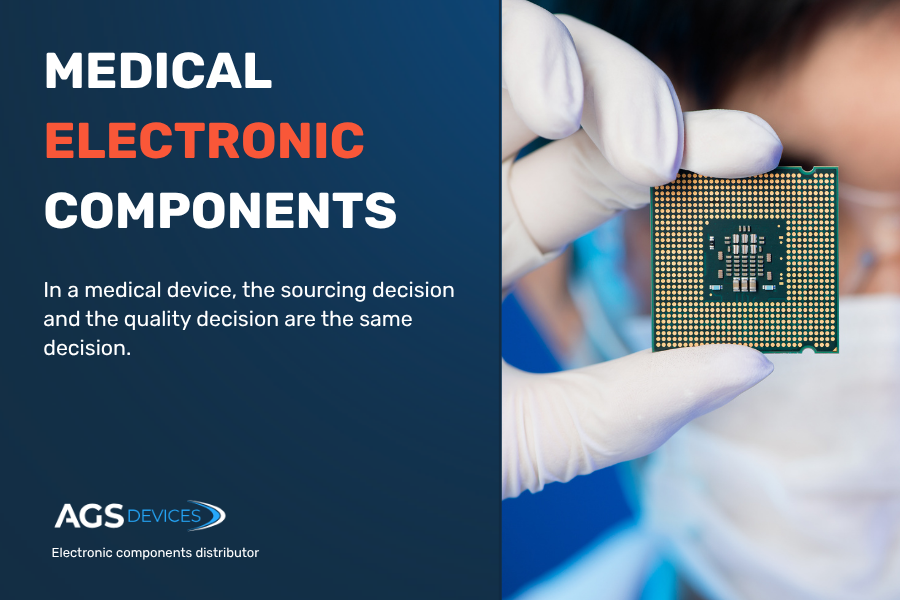
A capacitor that’s fine in a consumer gadget can be a patient-safety problem in an infusion pump, so the sourcing decision and the quality decision are really the same decision.
This guide covers both: the standards you’re building into, what to demand from a supplier, and how to handle obsolescence and counterfeit risk without putting a device, or a patient, at risk.
What Counts as a Medical Electronic Component?
Medical electronic components are the parts that let a device sense, process, power and display, all under the reliability and safety demands of healthcare. They show up across the whole device landscape:
- Sensors: measure vital signs, pressure, temperature and motion in monitors and wearables
- Microcontrollers and ICs: the processing behind diagnostics, imaging and infusion control
- Connectors and cable assemblies: carry signal and power where a loose contact isn’t an option
- Power components: regulators, converters and batteries that keep life-support and portable devices running
- Displays and optoelectronics: imaging sensors, photodetectors and indicators for diagnostic equipment
The application is what raises the stakes. The same part number can be routine in one product and safety-critical in another, which is why medical sourcing starts with the device’s risk class, not the parts list.
Why Medical Electronic Components Are Held to a Higher Standard
Medical electronic components answer to demands most consumer parts never face. Get this wrong and the consequences aren’t a returned gadget, they’re a recall or a harmed patient.
- Patient safety: a failure in a ventilator or pacemaker can be life-threatening, not just inconvenient
- Regulation: devices are among the most heavily regulated products in the world, and that scrutiny flows down to components
- Long lifecycles: medical equipment often stays in service for 10 to 20 years, far longer than the parts inside it remain in production
- Reliability under stress: parts must hold spec through years of duty cycles, sterilization, vibration and temperature swings
That last point is the real challenge. The device outlives its own components, so obsolescence isn’t a question of if but when, and how you plan for it.
The Quality and Regulatory Framework You’re Sourcing Into
You’re not just buying parts, you’re feeding a regulated quality system. Knowing the standards that govern the device tells you what your components and suppliers have to support, and which sourcing decisions carry the most weight.
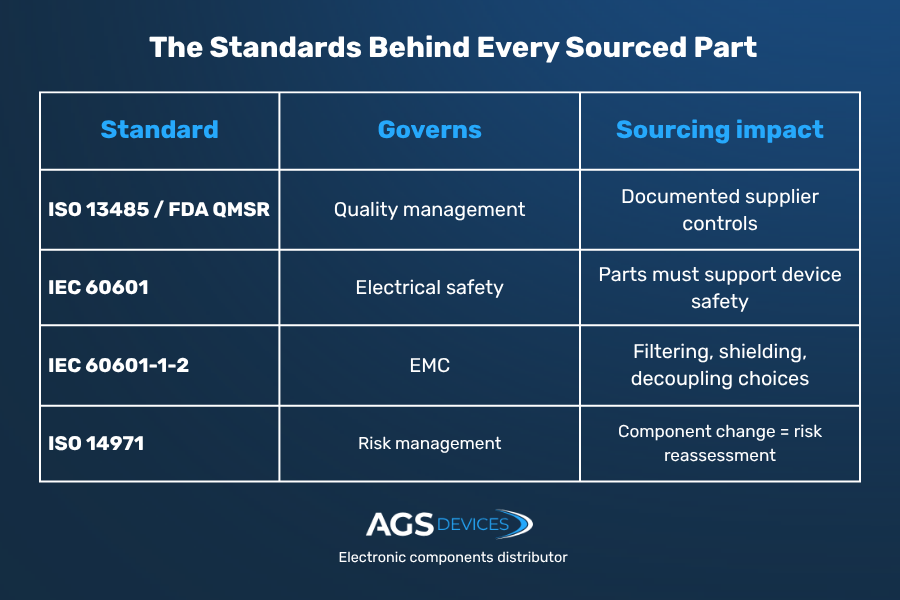
Quality Management (ISO 13485 and the FDA QMSR)
ISO 13485 is the quality management system standard for medical devices. As of February 2, 2026, the FDA’s QMSR incorporates it by reference into 21 CFR Part 820, per the FDA, so risk-based supplier management is now baked into U.S. device regulation.
In practice, it reaches straight into the parts of the system that touch your BOM:
- Supplier controls: vetting, monitoring and documenting the sources you buy from.
- Traceability: the ability to track a component back through your supply chain.
- Process validation: proving your sourcing and handling produce consistent, conforming parts.
- Change control: managing any change to a validated component or supplier.
The short version is that your component sources have to stand up to scrutiny, not simply deliver parts.
Electrical Safety (IEC 60601)
IEC 60601 is the series of standards for the basic safety and essential performance of medical electrical equipment, and compliance is often mandatory for market access.
The components you choose have to support the device across several fronts:
- Electrical safety: insulation, leakage current and protection against shock
- Mechanical and thermal safety: parts that stay within safe limits under load
- Software safety: where firmware-driven components are involved
A part that looks like a clean electrical match can still undermine compliance if it shifts thermal behavior or creepage distances, so check it against the device’s safety case, not just the datasheet.
Electromagnetic Compatibility (IEC 60601-1-2)
IEC 60601-1-2 is the EMC collateral standard in the 60601 series, and it’s the one your component choices decide more than any other. A device passes or fails on emissions and immunity, and most of the fixes live at the part level (test to Edition 4.1, IEC 60601-1-2:2014+AMD1:2020).
- EMC sign-off is a prerequisite for FDA 510(k)/PMA submissions and EU MDR market access
- The component levers are decoupling capacitors, ferrites and EMI filters, shielded connectors and cables, plus transient protection on power and signal lines
- Swapping a “compatible” capacitor or connector for one with different impedance, ESR or shielding can quietly change EMC behavior, so treat EMC-relevant parts as controlled
Pro tip: flag your EMC-critical parts (filters, ferrites, shielded connectors, decoupling networks) on the BOM so nobody value-engineers them out with a cheaper alternate that was never EMC-verified.
Risk Management (ISO 14971)
ISO 14971 governs risk management across the device lifecycle, and under the QMSR that risk-based thinking runs through the whole quality system. The takeaway for sourcing is simple: a component change isn’t just a purchasing event, it’s a potential change to the device’s risk profile that has to be assessed before it ships.
Traceability and Documentation
Traceability is the spine of medical quality. It proves a part is what it claims to be, and it’s what lets you investigate fast if something goes wrong in the field.
At the component level, that means demanding:
- Certificates of conformance on every lot
- A documented chain of custody back to the manufacturer or authorized channel
- Lot and date-code records you can tie to a specific build
For devices that sustain life, ISO 13485 traceability requirements (Clause 7.5.9.2, referenced in the QMSR) can even extend to distributors keeping distribution records.
Watch for change notifications too: ask component suppliers for PCN (Product or Process Change Notification) agreements, and route every PCN through your change-control process, because a quiet fab or material change can undo a qualification you already paid for.
Sourcing Medical Electronic Components: What To Look For
Medical components sourcing means supplier selection first and part selection second. A genuine part from an undocumented source still fails an audit. Vet every supplier against this list:
- Documented quality system: ISO 13485 alignment or ISO 9001 at minimum, with real supplier controls
- Full traceability: certificates of conformance and a chain of custody back to the manufacturer or authorized channel
- Counterfeit-avoidance standards: reference to SAE AS6081 and participation in industry reporting like the ERAI database
- In-house inspection and testing: the ability to verify authenticity and function, not just resell
- Compliance documentation: RoHS, REACH and conformance records delivered with the order, not chased afterward
Pro tip: Ask a prospective supplier for a sample traceability package before you commit. A medical-ready partner produces it without friction. If certificates of conformance are “available on request” but never quite arrive, that’s your answer.
Managing Obsolescence Without Triggering a Revalidation
Here’s the medical-specific trap. Once a device is validated, its BOM is effectively frozen, because swapping a component can require re-verification, re-validation and even a regulatory filing. So when a part goes end-of-life (EOL), you can’t just grab the nearest substitute.
You’ve got a few plays, in rough order of preference:
- Last-time-buy (LTB): secure enough validated stock to cover remaining production and service life, then store it correctly.
- Qualify an alternate early: if a replacement is unavoidable, validate it properly before you’re forced into it. Our guide to choosing alternative electronic parts walks through the matching and validation steps.
- Plan the sourcing route in advance: for parts already scarce, a structured approach beats a scramble, which is the focus of our guide on sourcing hard-to-find components.
The medical customers who run into real trouble are usually the ones who discover a part went EOL only after the BOM was locked under design controls.
Pro tip: Tie EOL and NRND monitoring to your validated BOM so engineering, quality and procurement see the same warning at once. In a regulated build, a surprise discontinuation isn’t just a delay, it can reopen your design file.
Counterfeit Risk Is a Patient-Safety Issue
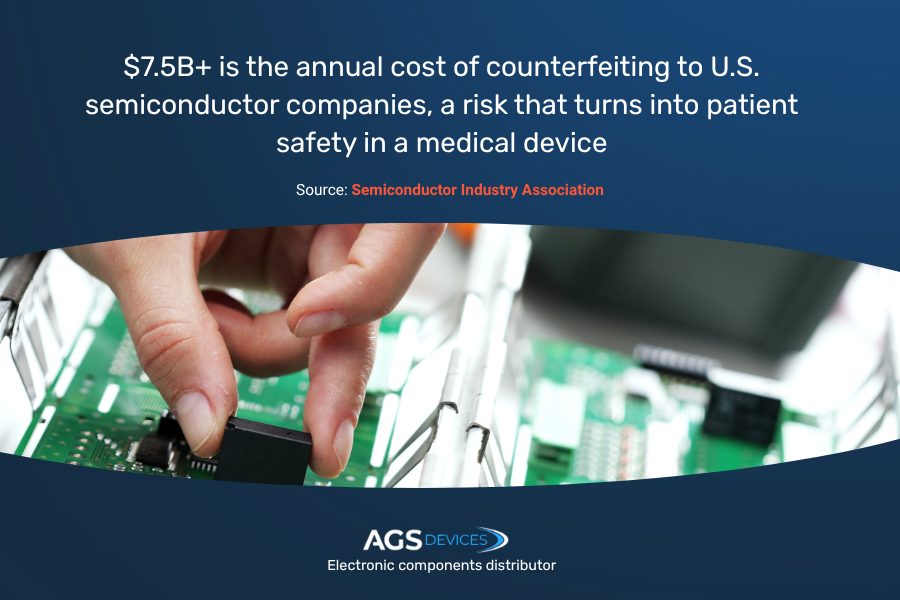
In most industries a counterfeit part is a cost problem. In a medical device it can be a life-or-death one.
The trend isn’t reassuring either: counterfeit and nonconforming part reports reached a nine-year high in 2024, with 1,055 suspect parts logged, a 25% jump over 2023.
Counterfeits often pass a casual inspection and fail later in the field, which is the worst possible outcome in a clinical setting.
Verify in layers, scaled to the part’s risk:
- Documentation review: cross-check part, lot and date codes against the certificate of conformance and packaging
- Visual inspection: look for resurfacing, mismatched markings or altered date codes
- X-ray: compare internal structure against a known-good sample without destroying the part
- Electrical and functional testing: confirm performance to spec before the part enters a build
The throughline is simple: buy from documented, certified sources, and treat a suspiciously cheap offer during a shortage as a warning, not a win.
Reliability and Storage Considerations
Even an authentic, correctly chosen part can fail if it’s mishandled. Medical reliability depends on getting the boring details right.
- Derating and margins: choose components with headroom on voltage, current and temperature so they hold up over a long service life.
- Temperature range: confirm the part is rated for the device’s real operating and sterilization conditions, not just lab conditions.
- Moisture sensitivity: store moisture-sensitive parts per JEDEC J-STD-033, with controlled temperature, humidity and ESD protection.
- Date-code discipline: older stock, especially LTB inventory, may need solderability checks before it’s used.
Pro tip: For long-life devices, document your storage and handling conditions the same way you document the parts themselves. If a part sat in inventory for years, an auditor will want to see it was stored to standard.
A Quick Checklist for Sourcing Medical Electronic Components
When a medical build needs parts, run this sequence:
- Identify the device risk class and the standards that apply (ISO 13485, IEC 60601, ISO 14971)
- Confirm the exact part spec, including derating and temperature margins
- Vet the supplier’s quality system, traceability and testing before you buy
- Demand certificates of conformance and compliance documentation up front
- Check lifecycle status and plan for EOL with an LTB or a pre-qualified alternate
- Verify authenticity proportional to risk, then document everything for the device file
Why Medical Device Makers Choose AGS Devices
AGS Devices is a medical components supplier built for the demands of regulated builds, with nearly two decades of experience sourcing for the healthcare sector.
Here’s what AGS Devices offers:
- A broad range of medical electronic components, from sensors and microcontrollers to connectors and cable assemblies
- Every product sourced, inspected and verified to meet healthcare-sector requirements, with traceability and certificates of conformance on request
- Shortage and obsolescence support, including help securing LTB stock and qualified alternates before production stalls
- A deep inventory and 24/7 technical support to keep device manufacturing and patient care uninterrupted
- BOM management that cross-references your list, flags EOL and NRND risk, and quotes verified availability fast
Medical Electronic Components: FAQs
Here are the questions device makers and buyers ask us most often about sourcing medical electronic components.
What are medical electronic components?
They’re the electronic parts inside medical devices, including sensors, microcontrollers, connectors, power components and displays. What sets them apart isn’t the part type but the application: they have to meet strict reliability, safety and traceability requirements because a failure can affect patient safety. The same component can be routine in one product and safety-critical in another.
What standards apply to medical electronic components?
At the device level, the key standards are ISO 13485 (quality management), IEC 60601 (electrical safety), and ISO 14971 (risk management), with IEC 62304 for software and ISO 10993 for biocompatibility. In the U.S., the FDA’s QMSR now incorporates ISO 13485 into 21 CFR Part 820.
Do component suppliers need to be ISO 13485 certified?
Not always certified themselves, but they must support your ISO 13485 obligations. Under the FDA’s QMSR, device makers are responsible for risk-based supplier controls, which means your sources need documented quality systems, traceability and conformance records.
Why is traceability so important for medica components?
Traceability proves a component is genuine and lets you track it if a problem surfaces. Medical quality systems require a documented chain of custody, and for life-sustaining devices those requirements can extend down to distribution records.
How do I handle a medical component going obsolete?
First confirm the end-of-life status, then weigh a last-time-buy against qualifying an alternate. Because a validated medical BOM is hard to change, a last-time-buy of validated stock is often the safest near-term move.
What’s a last-time-buy and when should I use one?
A last-time-buy (LTB) is your final purchase of a part before the manufacturer stops production. For medical devices, it’s valuable because it lets you keep using already-validated components and avoid a disruptive change.
How do I avoid counterfeit medical components?
Buy only from documented, certified sources, and require traceability and certificates of conformance on every lot. Insist on inspection and testing, including visual, X-ray and electrical checks where the risk warrants.
Can I use an alternative part in a medical device?
Yes, but only after full qualification. Unlike a quick swap in a consumer product, a medical alternate must be validated against electrical, mechanical, thermal and lifecycle requirements, and the change may trigger re-verification or regulatory notification.
What does the FDA QMSR mean for component sourcing?
The QMSR, effective February 2, 2026, incorporates ISO 13485 into 21 CFR Part 820 and emphasizes risk-based supplier controls. Practically, it reinforces that your component suppliers and their documentation are part of your regulated quality system.
How does AGS Devices support medical device manufacturers?
AGS Devices sources, inspects and verifies medical electronic components to healthcare-sector requirements, with traceability and certificates of conformance available on request. The team also helps with shortage and obsolescence challenges, including last-time-buy support and qualified alternates.