
Alternative Electronic Parts: Key Takeaways
- Alternative electronic parts replace a component you can’t get, but they rarely match it one-for-one, so the type of replacement you choose sets your whole validation workload
- The four replacement classes (drop-in, cross-reference equivalent, form-fit-function and functional equivalent) each carry a different level of risk and effort
- Counterfeit reports hit a nine-year high in 2024, and obsolete parts aren’t the only target, so authenticity testing isn’t optional
- A redesign can cost anywhere from $20,000 to $2 million, which is why a qualified alternate is almost always the cheaper path
Here’s the uncomfortable truth about modern sourcing: A component can disappear from the supply chain before you ever get a warning.
Industry data suggests roughly a quarter to a third of lifecycle changes happen with no product change notice at all, so plenty of buyers find out a part is gone only when they try to reorder and the stock is zero.
When that happens, you’re stuck shopping for alternative electronic parts. The replacement you pick determines whether your build ships on time or sits on the bench.
This guide gives you a working framework for choosing one: which type of replacement you need, how to validate it, and how to keep a counterfeit out of your supply chain. It’s written for the engineers who sign off on the spec and the buyers who have to source it.
What Are Alternative Electronic Parts?
An alternative electronic part is a component you use in place of one that’s unavailable, obsolete, too expensive, or stuck behind a long lead time.
It does the same job in your circuit, but it might come from a different manufacturer, carry a different part number, or differ slightly in spec. The whole skill is knowing how far it can drift before it stops being a safe swap.
Alternative vs. Equivalent vs. Drop-In
People use these three words interchangeably, and that’s where the trouble starts. Getting the vocabulary straight tells everyone on the team how much verification a given candidate needs:
- Equivalent: identical or near-identical specs to your original, often just a different brand or a newer revision of the same family.
- Drop-in replacement: matches the ratings, pinout and package so closely you change nothing on the board.
- Alternative: the broadest term. It performs the required function but may differ enough that you’ve got to verify it carefully before you trust it.
Why Parts Go Obsolete in the First Place
Components can have shorter lifecycles than the products they go into, and that mismatch is the root of the whole problem. Manufacturers retire a part when demand drops, when newer technology replaces it, or when they consolidate product lines.
Research from the University of Maryland’s CALCE group has made this point for years: The part’s life cycle is often far shorter than the life cycle of the equipment that depends on it.
When You Actually Need Alternative Electronic Parts
Nobody goes looking for alternative electronic parts for fun. You go looking when something’s blocking the build, and the trigger almost always falls into one of two buckets. Knowing which one you’re in tells you how much time you’ve got and how much risk you can stomach.
EOL and NRND Notices
When a manufacturer issues an End-of-Life (EOL) or Not Recommended for New Designs (NRND) notice, the clock starts running.
- An EOL notice usually comes with a Last-Time-Buy (LTB) date. Miss it and your easy options shrink fast.
- An NRND flag is the early warning: The part is still shipping, but it’s on the way out, so start qualifying alternates now rather than later.
- The gap that catches people: Many lifecycle changes arrive with no formal notice, so smaller buyers who aren’t on a manufacturer’s direct notification list often discover the problem at reorder.
In our experience reviewing customer BOMs, the most common issue we flag isn’t price, it’s a part that’s quietly slipped to NRND or EOL since the last design revision.
Pro tip: Set EOL and NRND watchlists against your live BOM so a status change pings procurement and engineering at the same time, not three weeks apart.
Shortages, Allocation and Long Lead Times
Sometimes the part still exists, but you can’t get it when you need it. Allocation, factory disruptions and demand spikes from sectors like EVs and aerospace push lead times out for months at a stretch.
In those cases an alternate isn’t about obsolescence at all, it’s about keeping the line moving while the original part is out of reach, then switching back once supply recovers.
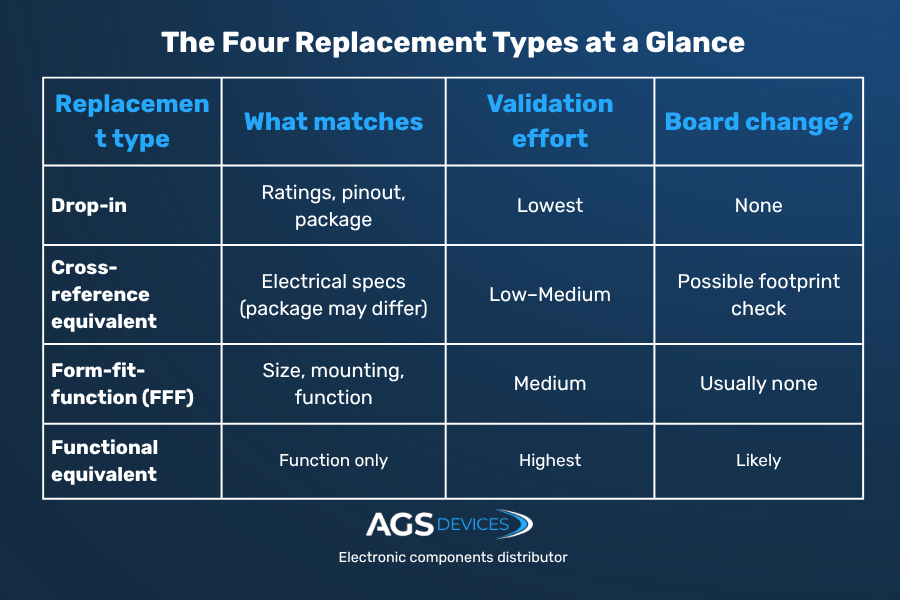
The Four Types of Replacement (Know Which One You Need)
Before you search, decide what kind of match you’re after. This one decision drives your validation effort and your redesign risk more than anything else.
1. Drop-In Replacement
This is the best-case scenario. The alternate shares the same electrical ratings, pinout and footprint, so you swap it in and touch nothing else. Common passives and discrete transistors usually have several drop-in options across manufacturers, which is why they almost never stall a build.
2. Cross-Reference Equivalent
A cross-reference equivalent meets the same electrical specs but might differ in package dimensions or pin naming. It’s usually a quick win, with one caveat worth repeating: identical packages can still hide subtle parameter mismatches like a lower maximum voltage rating or different thermal behavior. Verify the footprint and the datasheet before you commit.
3. Form-Fit-Function (FFF)
An FFF alternate matches the original’s physical size, mounting and functional performance, even when the internal design or technology differs. It’s the workhorse of obsolescence management, and the smart teams line these up in advance:
- Identify FFF candidates for each high-risk part before you need them
- Validate them technically and logistically (spec, pricing and sourcing) while you have time
- Check them against your approved vendor list and compliance requirements up front
Pro tip: Keep a pre-qualified alternates database tied to your BOM version history. When an EOL notice lands, you pivot in a day instead of starting the search cold.
4. Functional Equivalent
A functional equivalent does the same job but may need design changes: different support components, a tweaked layout, or new firmware. It’s the most flexible option and the most work, so reserve it for when nothing closer exists. If you’re heading down this road anyway, it’s often the moment to ask whether a small redesign buys you a part that won’t go obsolete again next year.
How To Evaluate an Alternate Part
Once you’ve found a candidate, it has to earn its place on the BOM. Run every alternate through these four checks, and don’t skip the boring ones, because the boring ones are where builds quietly fail.
Electrical Parameters
Compare the candidate against the original datasheet across the parameters that matter in your application:
- Operating voltage range, current ratings and logic levels.
- Timing characteristics, startup behavior and hysteresis.
- The application-specific specs that don’t show up in a basic filter, like ESR and ripple current in power circuits.
Mechanical, Footprint and Pinout
Confirm the physical part will actually fit and connect the way your layout expects. A pinout difference is the classic trap: two parts can share a package outline and still route their pins differently, which forces a board change you didn’t budget for. Check package dimensions, lead pitch and mounting footprint against your existing land pattern before anything else.
Thermal and Derating
Read the derating curves, not just the headline rating. A part rated correctly on paper can still underperform once it’s powered in your circuit.
Pro tip: MLCC capacitance can drop sharply under DC bias, so a capacitor that looks like a clean match by value can lose a big chunk of its effective capacitance at your working voltage. Always check the DC bias curve, not just the nameplate.
Lifecycle Status
There’s no sense qualifying an alternate that’s about to go obsolete itself. Confirm the replacement is in active production, then dual-source it where you can so a single discontinuation doesn’t drop you right back into the same hole. Treat lifecycle status as a hard gate: an NRND replacement is borrowed time.
Cross-Referencing Tools and Where To Start
You don’t have to hunt blind. A handful of resources surface candidates fast, and the efficient move is to start narrow, then widen the search only if you have to.
- Manufacturer cross-reference guides: Start with the original maker’s own replacement recommendation, often printed right in the discontinuation notice. Major semiconductor makers like Texas Instruments, Analog Devices and ON Semiconductor publish guides that map competitor part numbers to their equivalents
- Parametric search engines: When there’s no clean manufacturer swap, search by specification rather than part number to surface parts you’d never find by cross-reference alone
- Distributor and aggregator databases: Useful for live stock and lifecycle status across many sources at once
The rule that saves you: cross-reference tools show candidates, not guarantees. Always validate the suggestion against the full datasheet before it goes near production.
Avoiding Counterfeits When You Source Alternates
This is the part that separates a careful buyer from a burned one. The moment you step outside authorized distribution to chase an obsolete or allocated part, your counterfeit exposure jumps, and the data backs that up.
Why the Risk Is Rising
As we mentioned before, the risk of counterfeit components is growing, with 1,055 suspect parts logged, a 25% jump over 2023.
Two findings from that report should reshape how you think about risk:
- Obsolete components made up 42.75% of reports, the single biggest slice, exactly the parts you’re now hunting
- Active, readily available parts still accounted for more than a quarter of reports, and were faked more than twice as often as active parts with long lead times, per ERAI
The takeaway: scarcity isn’t the only thing that draws counterfeiters. Plenty of in-production parts get faked too, so “it’s easy to get” is not the same as “it’s safe.”
Verification and Testing
Verification works in layers, cheapest and fastest first:
- Documentation review: cross-check part, lot and date codes across the certificate of conformance, labels and packaging
- Visual inspection: look for mismatched date codes, blurry markings, resurfacing or bent leads.
- X-ray: compare internal structure, wire bonds and die against a known-good sample, without destroying the part
- Electrical and functional testing: prove the part performs to spec, ideally across its full temperature range
The alternates that fail our authenticity checks most often are the rushed buys from an unvetted broker during an allocation crunch.
Pro tip: If a price looks too good during a shortage, treat it as a red flag, not a win. Counterfeiters price to move, and ERAI’s data shows third-party test labs and independent distributors catch the large majority of fakes, while manufacturers report under 6%.
Certifications and Traceability
Lean on recognized standards so you’re not relying on a gut feel:
- SAE AS6081: counterfeit avoidance requirements for distributors
- SAE AS6171: the test methods for detecting suspect parts
- SAE AS9120 / IEC 62668-1: quality and counterfeit-prevention process standards used in aerospace and avionics
- Full traceability: certificates of conformance and a documented chain back to a verified source
Long-stored stock needs proper handling too. Moisture-sensitive parts should be kept per JEDEC J-STD-033 (controlled temperature and humidity, ESD protection), and stock with older date codes is worth solderability testing before it hits a reflow oven.
When To Redesign Instead
Sometimes there’s no good alternate, and forcing one is the wrong call. Redesign is the honest answer when:
- The part is safety-critical and no functional equivalent exists
- Every available candidate is itself obsolete or NRND
- The only stock has date codes old enough to raise reliability questions
A redesign isn’t cheap. That’s exactly why a properly qualified alternate usually wins. But designing a chronic problem part out for good can beat patching it twice, so weigh the one-time redesign cost against the recurring risk of a marginal substitute in a critical system.
Why Engineers and Buyers Choose AGS Devices for Alternative Electronic Parts
AGS Devices is an independent distributor built for exactly this problem: finding and verifying alternative electronic parts when the original isn’t an option.
Here’s what sets the team apart:
- Shortage and obsolescence sourcing across a vetted network of independent and authorized suppliers, plus excess-inventory channels
- BOM management that cross-references your list, flags EOL and NRND risk, and suggests pre-verified alternates before they stall production
- In-house inspection and testing on every lot, with traceability, test reports and certificates of conformance on request
- Compliance documentation (RoHS, REACH, CoC) standard with verified orders
Alternative Electronic Parts: FAQs
Here are the questions engineers and buyers ask us most often when choosing alternative electronic parts.
What is an alternative electronic component?
It’s a component used in place of one that’s unavailable, obsolete, or impractical to source. It performs the same function in your circuit, but it may come from a different manufacturer or differ slightly in specification. How closely it has to match depends on your application and how critical the part is to performance and safety.
What’s the difference between an alternative and an equivalent component?
An equivalent has identical or near-identical specifications to the original, often differing only by brand. An alternative is broader: it does the required job but may differ in spec, package, or features enough that you must validate it before use. Put simply, every drop-in is an equivalent, but not every alternative is a drop-in.
What is a drop-in replacement?
A drop-in replacement matches the original’s electrical ratings, pinout, and package closely enough that you change nothing on the board. It’s the lowest-risk, lowest-effort swap you can make. Common passives and discrete components usually have several drop-in options, while specialized ICs rarely do.
How do I cross-reference an obsolete part?
Start with the manufacturer’s own cross-reference guide, often included in the discontinuation notice. If that’s a dead end, use parametric search engines to find parts by specification rather than part number. Always confirm the suggested match against the full datasheet, since cross-references show candidates, not guaranteed fits.
What does form, fit, and function (FFF) mean?
FFF describes an alternate that matches the original’s physical form, board fit, and functional performance, even if the internal technology differs. It’s the most common solution when an exact replacement no longer exists. FFF parts let you keep your existing layout while restoring the function you lost.
Are alternative electronic parts safe for critical or aerospace systems?
Yes, when they’re properly qualified and sourced. Critical systems demand formal qualification testing to applicable standards, full traceability, and verified authenticity. The risk isn’t the alternate itself, it’s an unverified one, which is why aerospace and defense buyers insist on documented sourcing and lab testing.
How do I avoid counterfeit parts when sourcing alternates?
Source from distributors operating to anti-counterfeit standards like SAE AS6081, and require traceability and certificates of conformance. Insist on inspection and testing, including visual, X-ray, and electrical checks where the risk warrants. Be wary of prices that look too good and brokers outside your approved vendor list, especially during shortages.
What does NRND mean?
NRND stands for Not Recommended for New Designs. It’s a manufacturer signal that a part is heading toward end-of-life and shouldn’t go into new products, even though it’s still in production for now. Treat an NRND flag as your cue to start qualifying alternates early, before the LTB date forces your hand.
When should I redesign instead of finding an alternative?
Redesign when no functional equivalent exists, when the part is safety-critical and needs traceability you can’t get, or when every available substitute is itself obsolete. A redesign can run from $20,000 to $2 million, so it’s usually the last resort. If a qualified alternate exists, it’s almost always the cheaper, faster path.
Where can I buy obsolete or hard-to-find electronic components?
Through an independent distributor that specializes in constrained and obsolete parts, ideally one that tests and documents every lot. Authorized channels won’t carry discontinued stock, so you’ll need a partner with access to vetted independent and excess-inventory sources. Upload your BOM to a sourcing partner like AGS Devices to find and verify what you need.