
Semiconductor vs. Chip: Key Takeaways
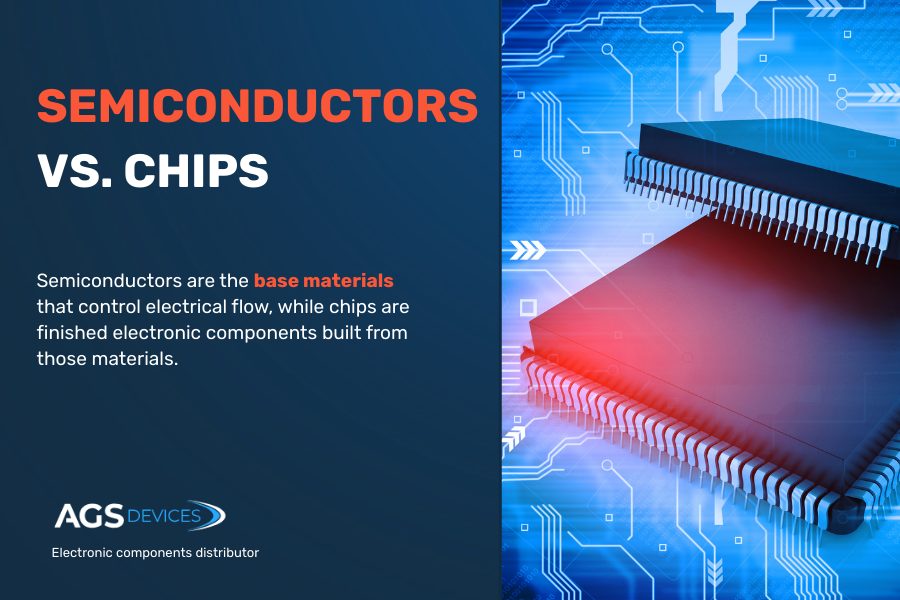
- A semiconductor is not a chip; it’s what chips are made from. Think of semiconductors as the unsung heroes of electronics, the raw ingredients behind the magic
- Microchips turn raw materials into function. These are silicon-based devices packed with transistors, built to process, store, or control data
- Integrated circuits are complete systems on a chip. They include all the essential components like transistors, resistors, and capacitors, working together in one unit
- Understanding the difference between semiconductor vs. chip matters. Inaccurate terminology can lead to sourcing mistakes, delays, and design mismatches
- Semiconductors are everywhere. They power everything from consumer electronics to aerospace control systems and advanced medical devices
- AGS Devices delivers what you need when you need it, as we help procurement and engineering teams source chips with precision and confidence
Is a chip the same as a semiconductor? What about an integrated circuit, is that just another name for a microchip?
These terms are everywhere in tech, yet even seasoned professionals sometimes use them interchangeably. In reality, each plays a distinct role in powering the electronic world around us.
More than 1 trillion microchips are produced globally every year, yet most are built on a material few consumers ever think about: semiconductors.
Whether you’re sourcing components, designing PCBs, or brushing up on electronics fundamentals, understanding the differences that distinguish semiconductors, microchips, and integrated circuits (ICs) from each other is essential.
In this guide, we’ll break down:
- What each term means
- The key differences between semiconductors, microchips, and ICs
- How these components power modern electronics
- Where each is used from smartphones to spacecraft
Semiconductors, Microchips & ICs: What They Are and How They Differ
These three terms often get tossed around casually, but each represents a unique layer in the electronics stack. From raw materials to functional systems, here’s how they connect.
Semiconductors: The Raw Material Behind Modern Tech
No semiconductors, no chips, plain and simple. These materials are the invisible backbone of just about every gadget and system we use today.
Here’s why semiconductors matter:
- Controlled conductivity: Their electrical behavior falls between conductors and insulators
- Material versatility: Common options include silicon, gallium arsenide (GaAs), and silicon carbide (SiC)
- Doping-friendly: Their conductivity can be fine-tuned by adding trace elements
- Foundational role: Every microchip and IC starts with a semiconductor substrate
Fun fact: Silicon is the second most abundant element in Earth’s crust after oxygen.
Controlling Current with Semiconductor Physics
What makes semiconductors so special? Here’s what: They don’t just sit there, they shape how electricity moves. They switch, amplify, and guide signals, which is why they’re at the heart of everything digital.
They enable modern electronics through:
- Switching functions: Used in transistors, diodes, and logic gates
- Signal control: Their conductivity changes based on electric fields or light
- Miniaturization: Transistors built on semiconductors can be packed by the billions on a single chip
- Doped regions: P-type and N-type zones allow for logic operations and signal routing
Did you know? Without semiconductors, there would be no processors, memory, or digital anything.
Microchips: Turning Raw Silicon Into Smart Devices
Once the semiconductor is processed, patterned, and packaged, you get a microchip. It’s where function begins.
Here’s what makes a chip a chip:
- Manufactured on silicon wafers: Each chip is sliced from a processed wafer
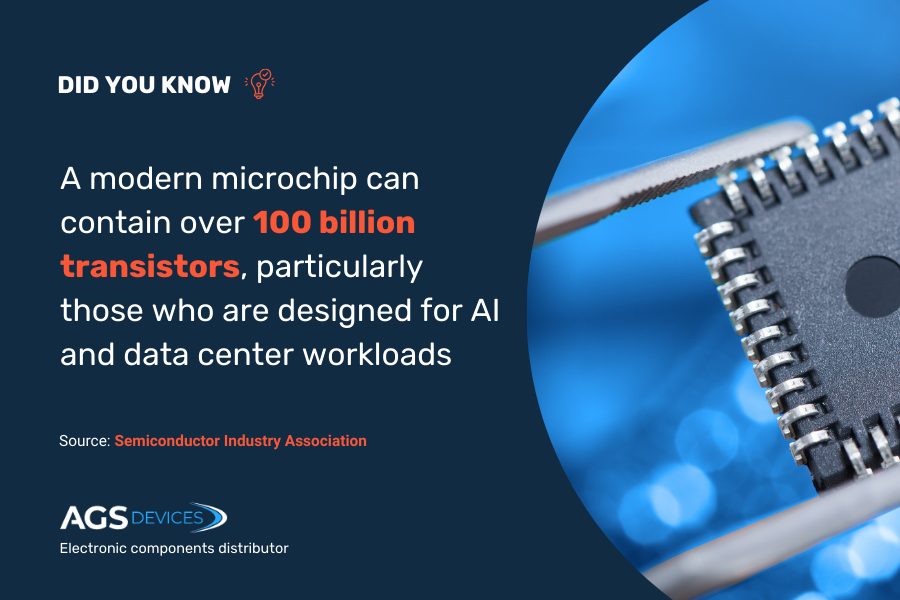
- High-density circuits: Modern chips can house over 50 billion transistors
- Packaged for use: Chips are enclosed in protective material and soldered onto circuit boards
- Used everywhere: Found in everything from phones to thermostats to satellites
Fun fact: The average smartphone contains over 100 chips, including processors, memory, sensors, and power ICs.
Integrated Circuits: Entire Systems on a Single Die
Think of ICs as the full package. They don’t just contain a few parts, they’re like miniaturized electronic ecosystems. Whether it’s logic, memory, or power control, everything’s integrated onto a single chip, ready to plug into just about anything
What sets ICs apart:
- Multifunction design: Combines transistors, resistors, capacitors, and more in one place
- Compact performance: Executes logic, control, amplification, or power regulation
- Cost-effective: Mass production makes ICs affordable for high-volume electronics
- Ubiquitous use: Found in computers, cars, appliances, medical equipment, you name it
By the numbers: Some ICs measure just a few millimeters but outperform room-sized computers from the 1960s.
Different Types of Integrated Circuits and What They Do
Not all ICs are created equal. Each is tailored to handle specific signal types or operations.
Explore the major IC categories:
- Analog ICs: Used in amplifiers, voltage regulators, and audio filters
- Digital ICs: Found in logic gates, microcontrollers, and processors
- Mixed-signal ICs: Handle both analog and digital, essential for ADCs, DACs, and RF systems
- Application-specific ICs (ASICs): Custom-designed for a single purpose
- SoCs and PLDs: System-on-Chips and programmable logic devices for high integration and flexibility
What you might not know: Today’s high-performance chips can contain over 50 billion transistors on a single piece of silicon no bigger than a fingernail. That’s more transistors on a single chip than stars in the Milky Way.
Key Differences: Semiconductor vs. Chip vs. IC
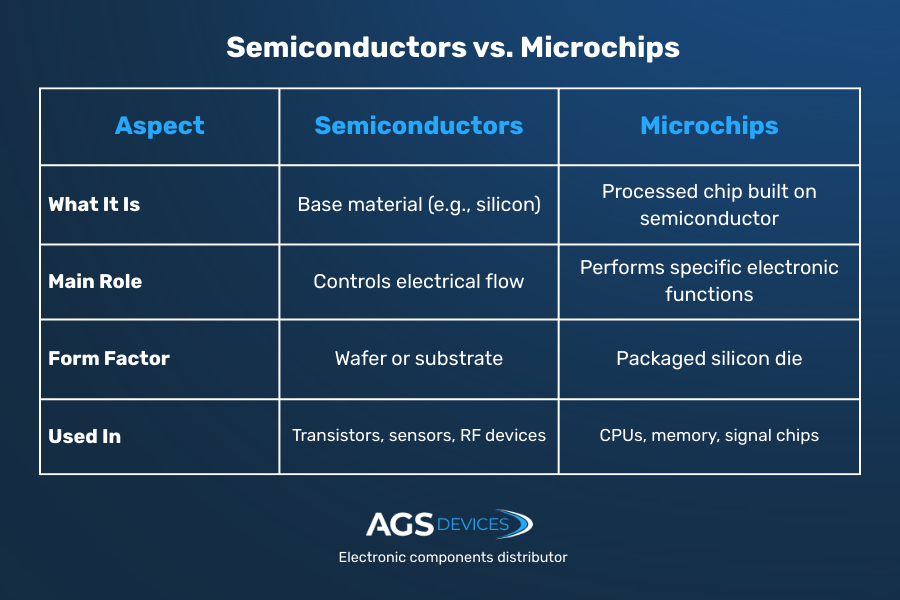
These terms are often used interchangeably, but they represent distinct levels of the electronics hierarchy. Here’s how they compare:
| Term | What it is | Role | Physical form |
| Semiconductor | A material (silicon, GaAs, SiC) | Enables conductivity control | Raw wafer or processed substrate |
| Microchip | A manufactured chip or die | Houses embedded circuits or logic | Silicon die, often encapsulated |
| Integrated Circuit | A specific type of microchip | Contains complete, miniaturized circuits | Packaged chip, soldered to boards |
To recap:
- Semiconductors are the raw materials
- Microchips are devices built from semiconductors
- Integrated circuits are a category of microchips with full circuit functionality
Think of it like this: Semiconductor → becomes → Microchip → may contain → Integrated Circuit
How These Components Work Together
Understanding the distinctions is useful, but seeing how these components fit together in real-world electronics is where it all clicks.
A Visual Analogy: From Ingredients to Final Dish
Think of the electronics hierarchy like baking:
- Semiconductor: Raw flour, the base ingredient that can’t do much on its own, but is essential
- Microchip: A baked cake, crafted from the raw material into a usable form
- Integrated Circuit (IC): A multi-layered cake, purpose-built, ready to serve, with layers (logic, memory, power) working together
Technical Breakdown
- Semiconductors are the foundational materials (like silicon or GaN) with electrical properties that can be controlled via semiconductor doping and fabrication
- Microchips are manufactured on top of semiconductors, containing transistors and circuits, essentially “activating” the material
- ICs take it further: they’re microchips with complete, self-contained electronic functions like amplifying signals, processing data, or storing memory
So every IC is a microchip, and every microchip is built on a semiconductor, each layer adding complexity and functionality.
Applications in Modern Electronics
From smartwatches to spacecraft, semiconductors, microchips, and ICs work together to drive the tech behind nearly every system we rely on.
Here’s where each one fits:
Semiconductors:
Used as the base material for fabricating:
- Transistors and diodes
- Photonic sensors and solar cells
- High-frequency RF components
Microchips:
Built on semiconductors, enabling functions like:
- Central processing units (CPUs) and GPUs
- Memory storage (DRAM, flash)
- Power management ICs and microcontrollers
Integrated Circuits (ICs):
These “complete circuit chips” power:
- Everything from smartphones and appliances to satellites
- Embedded systems in automotive, aerospace, medical, and industrial control
- High-reliability applications like avionics, medical implants, and defense systems
Fun fact: The average modern car contains over 1,400 ICs, controlling everything from engine timing to collision avoidance systems.
Why Understanding These Terms Matters and How AGS Devices Supports Your Supply Chain
Semiconductor vs. chip and integrated circuits aren’t just tech buzzwords; they’re the building blocks of modern electronics.
Knowing the difference helps engineers design better systems and helps procurement teams source exactly what they need with confidence.
At AGS Devices, we bridge the gap between design and delivery.
Whether you’re sourcing:
- Packaged microchips
- Specialized ICs for automotive, aerospace, or industrial systems
In addition to semiconductors, we also provide electronic components such as:
We don’t just source parts. We help you stay ahead of shortages, lead times, and obsolescence risks.
Semiconductor vs. Chip & IC: FAQs
Still unsure how semiconductor vs. chip and integrated circuits work? These quick answers clear up the most common questions engineers, students, and sourcing teams are asking.
Is a semiconductor the same as a chip?
No. A semiconductor is a raw material like silicon. A chip (or microchip) is a fabricated device built from semiconductor material.
What’s the difference between a microchip and an integrated circuit (IC)?
All ICs are microchips, but not all microchips are ICs. ICs contain a full electronic circuit with components like transistors, resistors, and capacitors on one chip.
Are semiconductors used in all electronics?
Yes. Semiconductors are the foundation of transistors, diodes, sensors, and integrated circuits found in nearly every modern electronic device.
Is a CPU an integrated circuit?
Yes. A CPU is a complex integrated circuit designed to perform high-speed logic operations and data processing.
Why does it matter if a part is called a chip or an IC?
Clarity matters in procurement and design. “Chip” is a broad term, while “IC” refers specifically to a circuit-level device. Knowing the difference helps avoid sourcing errors.
How can AGS Devices help with chip sourcing?
We provide global access to verified microchips and ICs, including end-of-life parts, with full traceability, lifecycle insights, and rapid delivery.
Are semiconductors the same as chips?
Not exactly. A semiconductor is the base material (like silicon), while a chip is a manufactured device built from that material to perform specific electronic functions.
Are semiconductors chips?
No. Semiconductors refer to the materials with electrical properties used to make chips. Chips are finished components that contain circuits built on semiconductors.